
Nano Banana 2 Localized Text Prompts: The Multilingual Infographic Masterclass.
TL;DR / Key Takeaways
Nano Banana 2 is Google's latest image model released on February 26, 2026. It uses Gemini's real-world knowledge to generate accurate infographics and data visualizations. It can render precise text in marketing mockups and translate that text into multiple languages directly inside the image. The model also supports subject consistency for up to five characters and resolutions up to 4K. You trigger these features using specific instructional prompt phrases.
Nano Banana 2 can translate text inside an image into multiple languages with near-perfect accuracy. This Masterclass shows you how to prompt for it.
Here is Topic #5, the Nano Banana 2 Localization & Infographic Masterclass. I have used the exact same premium, high-end print mockup style for your cover image.
CMS Metadata Fields
Post Title: Nano Banana 2 Localized Text Prompts: The Multilingual Infographic Masterclass
Slug: topimageprompt.com/blog/nano-banana-2-localized-text-infographic-prompts
Category: Masterclass
Tags: Nano Banana 2, Gemini 3.1 Flash, AI infographics, localized text, multilingual AI images, prompt engineering, Google Gemini, AI image prompts
SEO Title: Nano Banana 2 Localized Text Prompts: Multilingual Masterclass
Meta Description: Learn how to use Nano Banana 2 to generate accurate, localized infographics and multilingual text in AI images with these copy-ready prompt formulas. (148 chars)
Excerpt: Nano Banana 2 can translate text inside an image into multiple languages with near-perfect accuracy. This Masterclass shows you how to prompt for it.
TL;DR / Key Takeaways (AEO Summary): Nano Banana 2 is Google's latest image model released on February 26, 2026. It uses Gemini's real-world knowledge to generate accurate infographics and data visualizations. It can render precise text in marketing mockups and translate that text into multiple languages directly inside the image. The model also supports subject consistency for up to five characters and resolutions up to 4K. You trigger these features using specific instructional prompt phrases.
Nano Banana 2 Localized Text Prompts: The Multilingual Infographic Masterclass
Google's Nano Banana 2 model can translate text inside an image into multiple languages with near-perfect accuracy. This single capability changes how marketers and designers build global assets. You no longer need to generate an image in English and manually recreate the text in Spanish, French, or Japanese.
When Google launched Nano Banana 2 (Gemini 3.1 Flash Image) on February 26, 2026, they gave it real-world knowledge and live web search grounding. Most users still use it like an older image model. They ask for a picture of a cat and get a nice picture of a cat. They miss the advanced reasoning engine sitting right under the hood.
This Masterclass shows you how to unlock the infographic and localization features. You will learn the exact prompt phrases that force the model to do real work.
Why Text Rendering Finally Works
Older AI image models treat text like a texture. They draw shapes that look like words from a distance. When you get close, the letters melt into gibberish. Nano Banana 2 treats text as rendered language. It understands the characters, the grammar, and the layout.
Because the model pulls from Gemini's deep knowledge base, it can build infographics based on actual facts. It does not invent random percentages for a chart. It uses live web search to ground the data before it draws the layout. This means you can finally trust the numbers in your AI-generated charts.
How to Trigger Accurate Infographics
You must tell the model to use its reasoning capabilities. If you just ask for an infographic, it will fall back to pattern memory. You need to instruct it to research and structure the data.
Use these phrases in your prompt: * "Generate a data visualization based on factual information about..." * "Create a flat lay infographic depicting the..." * "Use accurate data points and labels"
When you use these phrases, the model switches into a research mode. It plans the information hierarchy before it renders the pixels. Google used a water cycle infographic in their launch demo to prove this works. The model placed accurate labels and arrows on the first try.
The Localization Prompt Trick
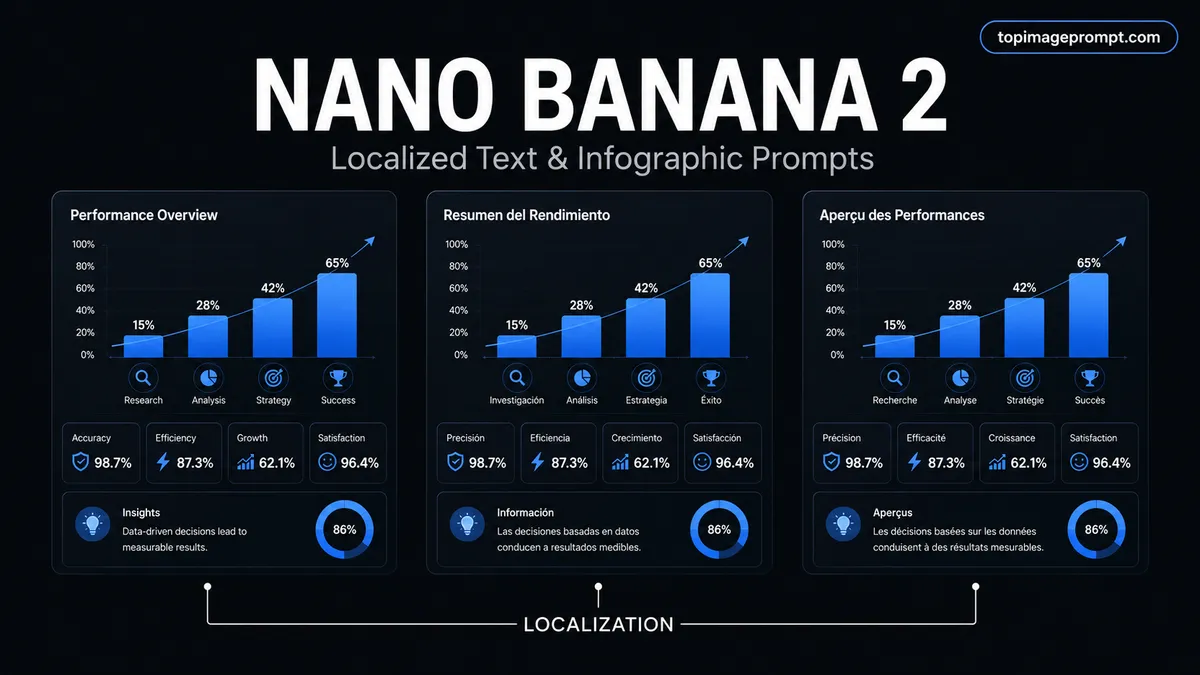
Localization is where Nano Banana 2 outshines every other image model on the market. You can ask it to generate a sign, a menu, or a poster, and then translate the text into multiple languages inside the same image.
The trick is to specify the exact languages and the layout. You tell the model what the primary language is, and then you list the translations you want below or beside it. The model understands the spatial relationship between the text blocks.
You can prompt it like this: "Create a museum sign that reads 'Native Wildlife' in English. Include accurate Spanish and French translations directly below the English text. Use a clean sans-serif typography."
The model renders the English text, translates it correctly, and places the Spanish and French text in the exact layout you requested. This saves design teams hours of manual Photoshop work.
Nano Banana 2 vs Nano Banana Pro
Google now has two main image models. You need to know when to use each one. Nano Banana 2 is the fast, default model. Nano Banana Pro is the premium, high-fidelity model.
| Feature | Nano Banana 2 (Flash) | Nano Banana Pro |
|---|---|---|
| Speed | Lightning fast | Slower, premium render |
| Best For | Rapid iteration, infographics, translation | High-end 4K assets, complex layouts |
| Text Rendering | Excellent, multilingual | Maximum precision |
| Cost | Lower API cost | Higher API cost |
Use Nano Banana 2 for your daily workflow, your infographics, and your localized assets. Escalate to Nano Banana Pro only when you need maximum visual fidelity for a final campaign deliverable.
Three Copy-Ready Prompts
Here are three prompts you can test right now in the Gemini app or via the API. Each one targets a specific capability.
The Factual Infographic Prompt: "Create a flat lay infographic depicting the water cycle. Use accurate data points and labels for evaporation, condensation, and precipitation. Plan a clean, modern layout with a blue and white color palette. Ensure all text is legible and spelled correctly."
The Multilingual Signage Prompt: "Design a modern museum entrance sign. The primary text reads 'Native Wildlife'. Generate accurate Spanish and French translations of the primary text and place them directly below the English text. Use a clean sans-serif typography on a dark wood background."
The Data Visualization Prompt: "Generate a data visualization based on factual information about global renewable energy adoption in 2025. Create a bar chart showing the top three energy sources. Include accurate percentage labels above each bar. Use a minimalist aesthetic with a white background and green accents."
Subject Consistency Across Scenes
Nano Banana 2 also solves the storyboard problem. It can maintain character resemblance for up to five characters in a single workflow. It also maintains the fidelity of up to 14 objects.
This means you can prompt the model to create a four-panel comic strip, and the main character will look the same in every panel. You no longer need to use reference image stitching or face-swapping tools. You just describe the character once, and then describe the actions in each panel. The model remembers the face and the outfit.
The End of Manual Translation
Nano Banana 2 marks the end of manual text translation in design mockups. You can now generate a global ad campaign from a single text prompt. The speed advantage is massive. You just need to prompt the model to use its reasoning and language capabilities.
Frequently Asked Questions
What is Nano Banana 2?+
Can Nano Banana 2 translate text inside an image?+
Does Nano Banana 2 generate accurate infographics?+
How many characters can Nano Banana 2 keep consistent?+
What resolution can Nano Banana 2 output?+
Sources & Citations
- Google, "Nano Banana 2: Combining Pro capabilities with lightning-fast speed" (Feb 26, 2026) — confirms model identity as Gemini 3.1 Flash Image, advanced world knowledge, precision text rendering and translation, subject consistency for up to five characters, and 512px to 4K resolution support. https://blog.google/innovation-and-ai/technology/ai/nano-banana-2 YingTu AI, "Imagen 4 vs Nano Banana in 2026: What to Use Before Imagen Retires" (Jun 21, 2026) — confirms the route split between Nano Banana 2 (fast iteration, edits) and Nano Banana Pro (premium, 4K, complex layout). https://yingtu.ai/en/blog/nano-banana-pro-vs-nano-banana-2-vs-imagen-4 Google AI for Developers, "Generate images using Imagen" (Gemini API docs) — confirms the migration from Imagen to Nano Banana models for all image generation tasks. https://ai.google.dev/gemini-api/docs/imagen