
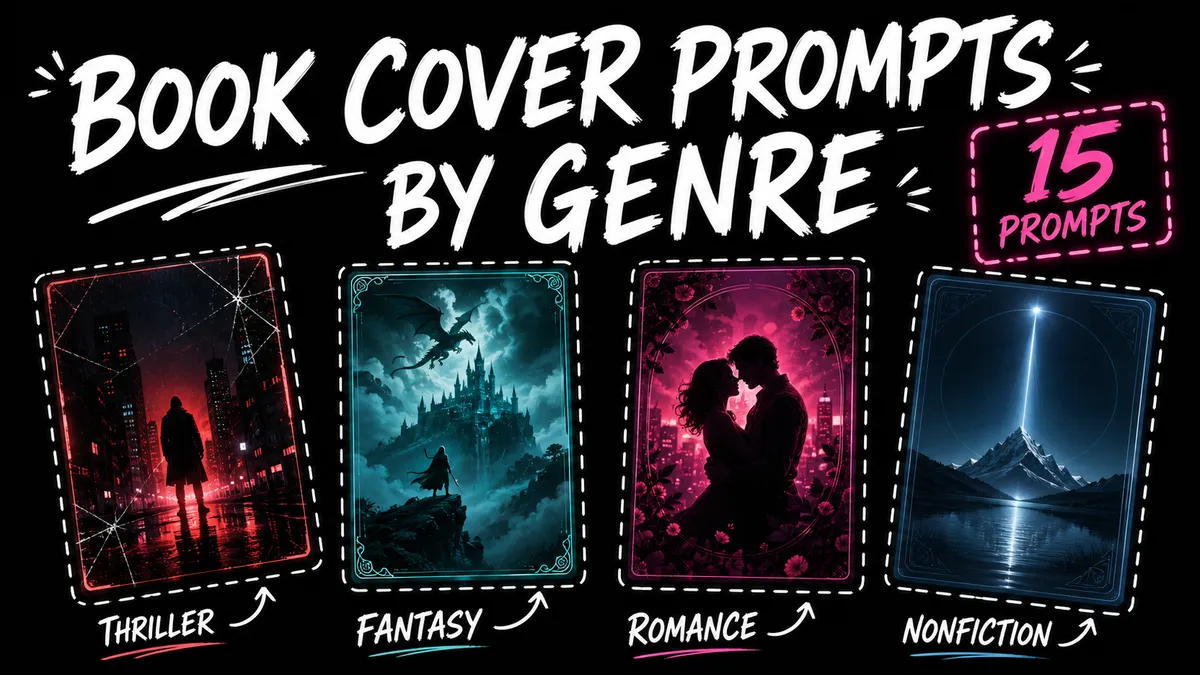
15 AI Book Cover Prompts by Genre: From Concept Art to KDP-Ready Design (2026)
Copy 15 AI book-cover prompts for thriller, romance, fantasy, sci-fi, memoir, nonfiction, and children’s books with a KDP finishing workflow.
On this page 34 sections
Key takeaways
Prompt the cover art around genre promise, one focal symbol, composition, color, and a deliberate title zone. Generate textless art when lettering must be exact, then finish title, subtitle, author name, spine, bleed, and barcode placement in a layout tool using the printer’s current template.
Copy 15 AI book-cover prompts for thriller, romance, fantasy, sci-fi, memoir, nonfiction, and children’s books with a KDP finishing workflow.
AI book cover prompts should begin with the real production decision, not a pile of style adjectives. This guide is written for independent authors, publishers, designers, and KDP creators. The 15 templates below are designed to create genre-correct cover art with a deliberate title zone and a production-safe finishing workflow.
> Direct answer: Begin with genre, audience, emotional promise, central conflict, trim size, title, author name, and examples of market positioning—not covers to copy. Define the single decision this image must communicate, explicitly protect the requested genre signal, central subject, title-safe area, hierarchy, trim orientation, original composition, and no imitation of a living artist or existing cover, and judge the result against the source before it is published or used commercially.
TL;DR
Prompt the cover art around genre promise, one focal symbol, composition, color, and a deliberate title zone. Generate textless art when lettering must be exact, then finish title, subtitle, author name, spine, bleed, and barcode placement in a layout tool using the printer’s current template.
Why AI book cover prompts need a dedicated workflow in 2026
For AI book cover prompts, a visually attractive output can still be unusable when the system changes facts the viewer assumes are real. The critical risk in this topic is not simply a weak aesthetic; it is losing the requested genre signal, central subject, title-safe area, hierarchy, trim orientation, original composition, and no imitation of a living artist or existing cover. A useful brief therefore separates the requested creative change from the evidence that must survive unchanged.
Current tools can follow natural-language edits and references, yet their own documentation still treats generation as iterative. For this task, that means planning around thumbnail readability, one strong focal image, controlled detail, clear value contrast, and enough bleed-safe background around the edges. When a pixel, measurement, spelling, logo, or regulated statement must be exact, finish that element with a conventional editing, layout, vector, or measurement tool.
A five-part formula for AI book cover prompts
Build each request in this order:
- Source for this task: state that you are providing genre, audience, emotional promise, central conflict, trim size, title, author name, and examples of market positioning—not covers to copy.
- Useful outcome: describe how the result will help independent authors, publishers, designers, and KDP creators.
- Truth locks: copy the non-negotiable list—the requested genre signal, central subject, title-safe area, hierarchy, trim orientation, original composition, and no imitation of a living artist or existing cover.
- Visual behavior: require thumbnail readability, one strong focal image, controlled detail, clear value contrast, and enough bleed-safe background around the edges.
- Final delivery: name the crop, safe areas, variation count, exclusions, and real publishing context.
This order makes omissions visible. If a requested detail is absent from the source and the brief, the generator must guess; in AI book cover prompts, that guess can quietly become the most noticeable part of the image.
AI book cover prompts preflight
Before opening a generator, collect and verify:
- genre, audience, emotional promise, central conflict, trim size, title, author name, and examples of market positioning—not covers to copy;
- permission for every supplied likeness, product, artwork, room, or private location;
- the exact facts the viewer could reasonably interpret as true;
- the final aspect ratio and smallest display size;
- one primary visual decision for the first pass;
- a side-by-side review method for the requested genre signal, central subject, title-safe area, hierarchy, trim orientation, original composition, and no imitation of a living artist or existing cover; and
- a non-generative fallback for precision typography, vectors, dimensions, or compliance details.
15 copy-ready AI book cover prompts
1. Psychological thriller
Use the supplied reference image for this AI book cover prompts task.

GOAL:
Create a restrained dark cover with one unsettling domestic object, strong negative space, and a narrow light source; reserve the upper third for title.

PRESERVE / REQUIRE:
- the requested genre signal, central subject, title-safe area, hierarchy, trim orientation, original composition, and no imitation of a living artist or existing cover
- thumbnail readability, one strong focal image, controlled detail, clear value contrast, and enough bleed-safe background around the edges
- the requested composition, original aspect ratio when editing, and no unrequested objects

Return one polished psychological thriller variation. Exclude watermarks, fake signatures, fabricated claims, and unreadable decorative text.
2. Cozy mystery
Use the supplied reference image for this AI book cover prompts task.

GOAL:
Create a warm small-town scene with one clue object, charming storefront detail, and readable uncluttered title space.

PRESERVE / REQUIRE:
- the requested genre signal, central subject, title-safe area, hierarchy, trim orientation, original composition, and no imitation of a living artist or existing cover
- thumbnail readability, one strong focal image, controlled detail, clear value contrast, and enough bleed-safe background around the edges
- the requested composition, original aspect ratio when editing, and no unrequested objects

Return one polished cozy mystery variation. Exclude watermarks, fake signatures, fabricated claims, and unreadable decorative text.
3. Epic fantasy
Use the supplied reference image for this AI book cover prompts task.

GOAL:
Use one original landmark or relic, a small human silhouette for scale, atmospheric depth, and a clear central title zone.

PRESERVE / REQUIRE:
- the requested genre signal, central subject, title-safe area, hierarchy, trim orientation, original composition, and no imitation of a living artist or existing cover
- thumbnail readability, one strong focal image, controlled detail, clear value contrast, and enough bleed-safe background around the edges
- the requested composition, original aspect ratio when editing, and no unrequested objects

Return one polished epic fantasy variation. Exclude watermarks, fake signatures, fabricated claims, and unreadable decorative text.
4. Romantasy
Use the supplied reference image for this AI book cover prompts task.

GOAL:
Combine one symbolic weapon or crown with botanical forms, luminous restrained color, and elegant negative space without character-face clichés.

PRESERVE / REQUIRE:
- the requested genre signal, central subject, title-safe area, hierarchy, trim orientation, original composition, and no imitation of a living artist or existing cover
- thumbnail readability, one strong focal image, controlled detail, clear value contrast, and enough bleed-safe background around the edges
- the requested composition, original aspect ratio when editing, and no unrequested objects

Return one polished romantasy variation. Exclude watermarks, fake signatures, fabricated claims, and unreadable decorative text.
5. Contemporary romance
Use the supplied reference image for this AI book cover prompts task.

GOAL:
Use one intimate setting detail, warm editorial color, and a modern graphic composition instead of a generic embracing couple.

PRESERVE / REQUIRE:
- the requested genre signal, central subject, title-safe area, hierarchy, trim orientation, original composition, and no imitation of a living artist or existing cover
- thumbnail readability, one strong focal image, controlled detail, clear value contrast, and enough bleed-safe background around the edges
- the requested composition, original aspect ratio when editing, and no unrequested objects

Return one polished contemporary romance variation. Exclude watermarks, fake signatures, fabricated claims, and unreadable decorative text.
6. Hard science fiction
Use the supplied reference image for this AI book cover prompts task.

GOAL:
Create an original engineered object or orbital structure with precise scale cues and a cool minimal typographic zone.

PRESERVE / REQUIRE:
- the requested genre signal, central subject, title-safe area, hierarchy, trim orientation, original composition, and no imitation of a living artist or existing cover
- thumbnail readability, one strong focal image, controlled detail, clear value contrast, and enough bleed-safe background around the edges
- the requested composition, original aspect ratio when editing, and no unrequested objects

Return one polished hard science fiction variation. Exclude watermarks, fake signatures, fabricated claims, and unreadable decorative text.
7. Space opera
Use the supplied reference image for this AI book cover prompts task.

GOAL:
Create a sweeping original planetary composition with one hero craft, strong color contrast, and no recognizable franchise design.

PRESERVE / REQUIRE:
- the requested genre signal, central subject, title-safe area, hierarchy, trim orientation, original composition, and no imitation of a living artist or existing cover
- thumbnail readability, one strong focal image, controlled detail, clear value contrast, and enough bleed-safe background around the edges
- the requested composition, original aspect ratio when editing, and no unrequested objects

Return one polished space opera variation. Exclude watermarks, fake signatures, fabricated claims, and unreadable decorative text.
8. Literary fiction
Use the supplied reference image for this AI book cover prompts task.

GOAL:
Use one metaphorical object, tactile photographic texture, restrained palette, and generous negative space.

PRESERVE / REQUIRE:
- the requested genre signal, central subject, title-safe area, hierarchy, trim orientation, original composition, and no imitation of a living artist or existing cover
- thumbnail readability, one strong focal image, controlled detail, clear value contrast, and enough bleed-safe background around the edges
- the requested composition, original aspect ratio when editing, and no unrequested objects

Return one polished literary fiction variation. Exclude watermarks, fake signatures, fabricated claims, and unreadable decorative text.
9. Memoir
Use the supplied reference image for this AI book cover prompts task.

GOAL:
Create a dignified symbolic or location-based image that reflects the supplied life theme without inventing events.

PRESERVE / REQUIRE:
- the requested genre signal, central subject, title-safe area, hierarchy, trim orientation, original composition, and no imitation of a living artist or existing cover
- thumbnail readability, one strong focal image, controlled detail, clear value contrast, and enough bleed-safe background around the edges
- the requested composition, original aspect ratio when editing, and no unrequested objects

Return one polished memoir variation. Exclude watermarks, fake signatures, fabricated claims, and unreadable decorative text.
10. Business nonfiction
Use the supplied reference image for this AI book cover prompts task.

GOAL:
Create a bold conceptual graphic with one visual metaphor, clean background, and strong hierarchy for title and subtitle.

PRESERVE / REQUIRE:
- the requested genre signal, central subject, title-safe area, hierarchy, trim orientation, original composition, and no imitation of a living artist or existing cover
- thumbnail readability, one strong focal image, controlled detail, clear value contrast, and enough bleed-safe background around the edges
- the requested composition, original aspect ratio when editing, and no unrequested objects

Return one polished business nonfiction variation. Exclude watermarks, fake signatures, fabricated claims, and unreadable decorative text.
11. Self-help
Use the supplied reference image for this AI book cover prompts task.

GOAL:
Use a fresh transformation metaphor, optimistic but restrained color, and clean readable space without cliché mountain peaks.

PRESERVE / REQUIRE:
- the requested genre signal, central subject, title-safe area, hierarchy, trim orientation, original composition, and no imitation of a living artist or existing cover
- thumbnail readability, one strong focal image, controlled detail, clear value contrast, and enough bleed-safe background around the edges
- the requested composition, original aspect ratio when editing, and no unrequested objects

Return one polished self-help variation. Exclude watermarks, fake signatures, fabricated claims, and unreadable decorative text.
12. Historical fiction
Use the supplied reference image for this AI book cover prompts task.

GOAL:
Create a period-aware object or place with accurate material culture, cinematic atmosphere, and no modern details.

PRESERVE / REQUIRE:
- the requested genre signal, central subject, title-safe area, hierarchy, trim orientation, original composition, and no imitation of a living artist or existing cover
- thumbnail readability, one strong focal image, controlled detail, clear value contrast, and enough bleed-safe background around the edges
- the requested composition, original aspect ratio when editing, and no unrequested objects

Return one polished historical fiction variation. Exclude watermarks, fake signatures, fabricated claims, and unreadable decorative text.
13. Horror
Use the supplied reference image for this AI book cover prompts task.

GOAL:
Create psychological tension using absence, shadow, and one uncanny detail without graphic violence or copied monster designs.

PRESERVE / REQUIRE:
- the requested genre signal, central subject, title-safe area, hierarchy, trim orientation, original composition, and no imitation of a living artist or existing cover
- thumbnail readability, one strong focal image, controlled detail, clear value contrast, and enough bleed-safe background around the edges
- the requested composition, original aspect ratio when editing, and no unrequested objects

Return one polished horror variation. Exclude watermarks, fake signatures, fabricated claims, and unreadable decorative text.
14. Children’s picture book
Use the supplied reference image for this AI book cover prompts task.

GOAL:
Create an original friendly character and simple environment with clear shapes, warm emotion, and room for large title lettering.

PRESERVE / REQUIRE:
- the requested genre signal, central subject, title-safe area, hierarchy, trim orientation, original composition, and no imitation of a living artist or existing cover
- thumbnail readability, one strong focal image, controlled detail, clear value contrast, and enough bleed-safe background around the edges
- the requested composition, original aspect ratio when editing, and no unrequested objects

Return one polished children’s picture book variation. Exclude watermarks, fake signatures, fabricated claims, and unreadable decorative text.
15. Poetry collection
Use the supplied reference image for this AI book cover prompts task.

GOAL:
Create an abstract tactile composition with one recurring symbol, subtle color, and quiet negative space.

PRESERVE / REQUIRE:
- the requested genre signal, central subject, title-safe area, hierarchy, trim orientation, original composition, and no imitation of a living artist or existing cover
- thumbnail readability, one strong focal image, controlled detail, clear value contrast, and enough bleed-safe background around the edges
- the requested composition, original aspect ratio when editing, and no unrequested objects

Return one polished poetry collection variation. Exclude watermarks, fake signatures, fabricated claims, and unreadable decorative text.
A production workflow built for AI book cover prompts
1. Archive the evidence before editing
Keep genre, audience, emotional promise, central conflict, trim size, title, author name, and examples of market positioning—not covers to copy untouched and give it a clear filename. In a separate note, record the requested genre signal, central subject, title-safe area, hierarchy, trim orientation, original composition, and no imitation of a living artist or existing cover. This turns subjective review into a comparison task. The preservation pattern in GPT Image 2 prompt framework can be adapted to the exact source used here.
2. Test the clearest use case first
Start with psychological thriller, cozy mystery, epic fantasy. Choose the example closest to the real deliverable, then change only the scene or presentation requested by that template. Do not combine several templates until one baseline output passes the truth-lock review.
3. Review the physics that make this result believable
For AI book cover prompts, inspect thumbnail readability, one strong focal image, controlled detail, clear value contrast, and enough bleed-safe background around the edges. Zoomed-in polish cannot rescue a wrong silhouette, implausible contact point, changed face, false room geometry, or misleading product relationship. Reject structural errors before spending time on color and styling.
4. Finish exact communication outside the generator
Names, prices, measurements, credentials, ingredients, logos, legal copy, and small labels deserve a separate verification pass. Generate a clean composition and enough negative space, then place critical wording in a layout tool where spelling, contrast, and alignment can be controlled.
5. Stress-test a second delivery context
Use self-help, historical fiction, horror as reminders that the same concept may be viewed in another crop, device, audience, or channel. Inspect the full-resolution file for defects, then inspect the actual card, thumbnail, feed, listing, print, or profile size for hierarchy and legibility.
6. Preserve the decision trail
For every accepted AI book cover prompts result, save the source filename, exact prompt, model, date, settings, chosen output, rejected issue, and manual corrections. That record makes a later update reproducible instead of forcing the team to reverse-engineer an image.
AI book cover prompts: common failures and targeted fixes
| Failure in this task | Likely cause | Better correction |
|---|---|---|
| The result no longer preserves the requested genre signal, central subject, title-safe area, hierarchy, trim orientation, original composition, and no imitation of a living artist or existing cover | The brief described the new look but never made the source facts non-negotiable | Paste the truth-lock sentence before the style request and compare every output side by side |
| The concept does not help independent authors, publishers, designers, and KDP creators | The model received visual adjectives without a real viewer or decision | State the audience, placement, message, and one action the visual should support |
| The scene feels physically wrong | The request omitted thumbnail readability, one strong focal image, controlled detail, clear value contrast, and enough bleed-safe background around the edges | Add camera, scale, light, contact, material, and perspective constraints that apply to this source |
| A required label or statement is nearly correct | Lettering was generated as image texture rather than typeset information | Reserve a clean text zone and place verified wording in a layout editor |
| Later versions drift away from the approved source | A flawed generated output was repeatedly used as the next reference | Return to the last verified source and apply one narrowly described change |
| The output looks impressive but implies something untrue | Creative freedom was not separated from factual presentation | Remove the unsupported cue and label generated, reconstructed, staged, or illustrative content when relevant |
Internal resources for this workflow
- GPT Image 2 prompt framework
- Ideogram layout prompting guide
- portrait on a wine label prompt
- portrait on a chocolate box prompt
Each link above addresses a nearby task in the AI book cover prompts process: source preservation, a model-specific workflow, or a ready-made prompt example. Use the relevant link at the point where the reader needs it instead of treating internal links as an unrelated recommendation block.
Rights and truthful use for AI book cover prompts
Do not imitate a living artist or copy an existing cover. Verify image, font, and model licensing, and disclose AI-generated content wherever the publishing platform requires it.
Before release, a human reviewer should check permissions, licensing, trademarks, accessibility, representation, and every factual implication specific to create genre-correct cover art with a deliberate title zone and a production-safe finishing workflow. The model can produce a draft; responsibility for the published claim remains with the person or organization using it.
Final AI book cover prompts quality check
- Does the image clearly create genre-correct cover art with a deliberate title zone and a production-safe finishing workflow?
- Does it still preserve the requested genre signal, central subject, title-safe area, hierarchy, trim orientation, original composition, and no imitation of a living artist or existing cover?
- Does the rendering show thumbnail readability, one strong focal image, controlled detail, clear value contrast, and enough bleed-safe background around the edges?
- Are names, labels, numbers, logos, credentials, prices, and claims verified?
- Are key edges and repeated details intact at 100% zoom?
- Does the hierarchy survive the real aspect ratio and smallest display size?
- Would a reasonable viewer understand what is generated, edited, staged, restored, or illustrative?
- Has the rights holder and a relevant human reviewer approved the final use?
Final answer
Effective AI book cover prompts make the requested change easy to see and the protected facts easy to audit. Pick the closest template, replace every placeholder with the real source and delivery details, run one focused generation, and reject any output that weakens the truth locks. That disciplined loop is more reusable than chasing a longer list of aesthetic adjectives.
Frequently asked questions
What should a good AI book cover prompt include?
Which AI image model should I use for AI book cover prompts?
Why does the AI change details I did not ask it to change?
Should I generate important text inside the image?
How many variations should I create?
Can I use the generated result commercially?
Sources and further reading
- OpenAI Developers: GPT Image 2 model documentation — https://developers.openai.com/api/docs/models/gpt-image-2
- OpenAI Developers: Image generation and editing guide — https://developers.openai.com/api/docs/guides/image-generation
- Google AI for Developers: Gemini image generation and editing — https://ai.google.dev/gemini-api/docs/image-generation
- Adobe: The Ultimate Guide to Firefly 2026 — https://www.adobe.com/content/dam/cc/tnt/emea/intl1202/Firefly_Prompt_Guide_2026_EN.pdf
- Amazon KDP: Cover calculator and templates — https://kdp.amazon.com/cover-calculator
- Amazon KDP: Content guidelines — https://kdp.amazon.com/en_US/help/topic/G200672390
- U.S. Copyright Office: Copyright and Artificial Intelligence — https://www.copyright.gov/ai/