
Key instructions to preserve
No beautification, no face reshaping, no expression change unless stated.
GuardrailThe astronomy red lighting must be physically accurate — deep red, no other color contamination.
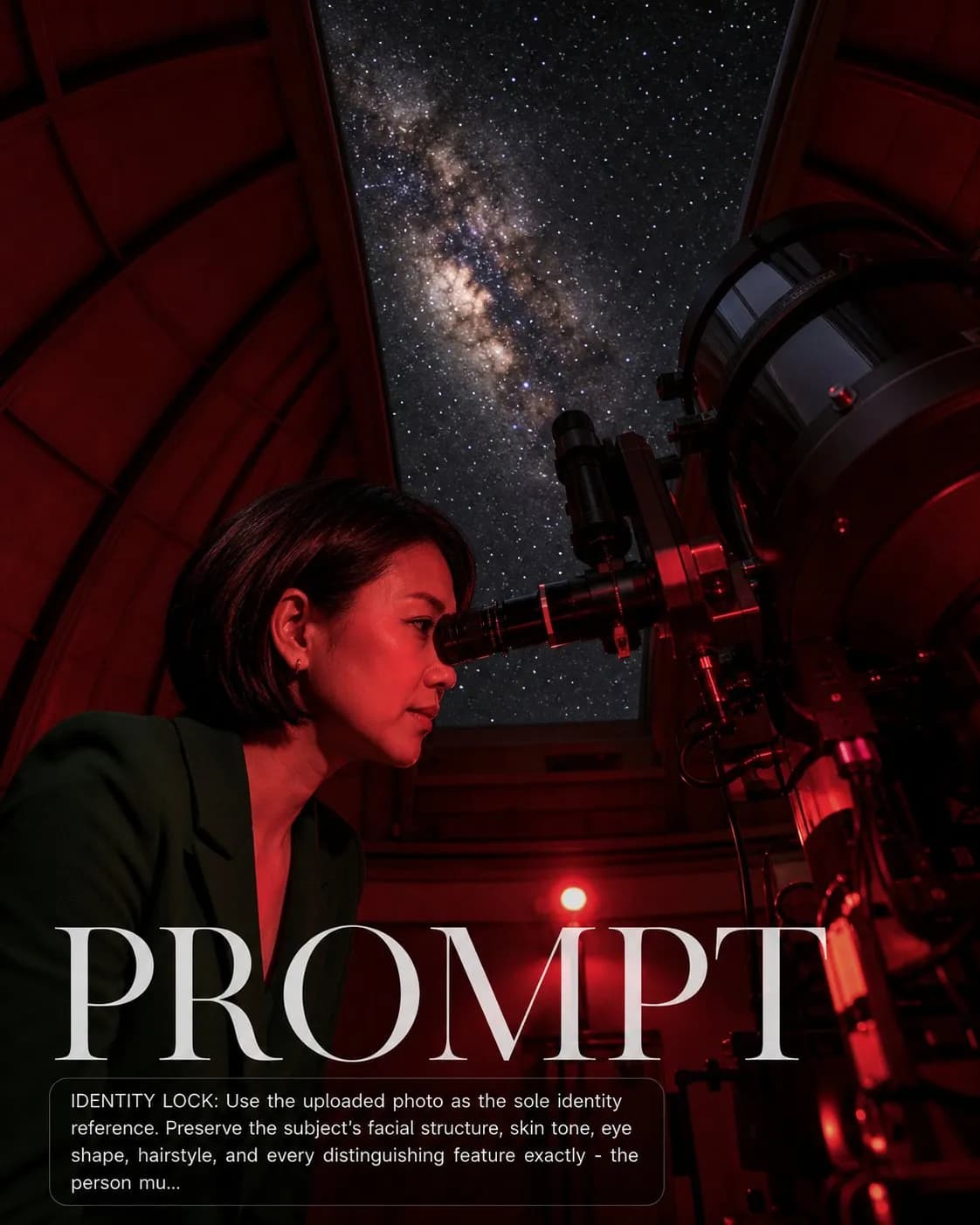
IDENTITY LOCK: Use the uploaded photo as the sole identity reference. Preserve the subject's facial structure, skin tone, eye shape, hairstyle, and every distinguishing feature exactly — the person must remain instantly recognizable. No beautification, no face reshaping, no expression change unless stated. SCENE: Subject at the eyepiece of a massive observatory telescope inside a domed facility at 2AM — the dome's slit open revealing the Milky Way above, the telescope illuminated by a single red astronomy lamp preserving night vision, the subject's face partially lit in that deep red glow. PHYSICS & CRAFT: Astronomy red light physics — 630nm red LED, the only light source in the dome, chosen specifically because it doesn't contract the pupil or ruin dark adaptation. The red light creates an unusual and dramatic portrait illumination — the subject's face in deep red with no cool fill whatsoever. The Milky Way through the dome slit is correctly rendered — the galactic center, star density, faint nebulosity. TECHNICAL EXECUTION: 35mm f/2.0, the telescope dominating the frame with the subject at the eyepiece, the dome slit framing the star field above, the red work light as the only light source — a technically unusual and visually striking portrait. HARD CONSTRAINTS: The astronomy red lighting must be physically accurate — deep red, no other color contamination. The Milky Way must be astronomically plausible. The subject's face under pure red illumination must still be recognizable.
0 people have copied this prompt
Telescope Observation Dome at Night is a photorealistic prompt for GPT Image 2, composed for a 4:5 image. No beautification, no face reshaping, no expression change unless stated.
No beautification, no face reshaping, no expression change unless stated.
Keep the prompt structure, then replace the main subject, action, or environment in "No beautification, no face reshaping, no expression change unless stated.".
Adjust one visual signal at a time, such as "35mm", "f/2.0", "ai image prompt", "science & discovery", so you can identify which instruction changes the result.
Keep the focal subject prominent in the portrait frame while preserving enough background detail for feed and poster layouts.
Use one clear reference image and retain the identity-lock instructions when changing clothing, lighting, background, or camera direction.
Use direct natural-language edits after the first generation. State what must remain unchanged before describing the single element you want to revise.
Judge the result by believable materials, natural anatomy, coherent light direction, and a camera perspective that matches the scene.
Three simple steps to generate your AI image.
Click the "Copy Full Prompt" button above to copy the entire prompt text to your clipboard instantly.
Open your preferred image generator and paste the prompt into the text input. You're ready to create.
Hit generate and watch the magic happen. Tweak the prompt parameters to make it your own.