
Key instructions to preserve
No beautification, no face reshaping, no expression change unless stated.
GuardrailThe transmitted light through the wine onto the face must be physically accurate — the glass acts as a color gel.
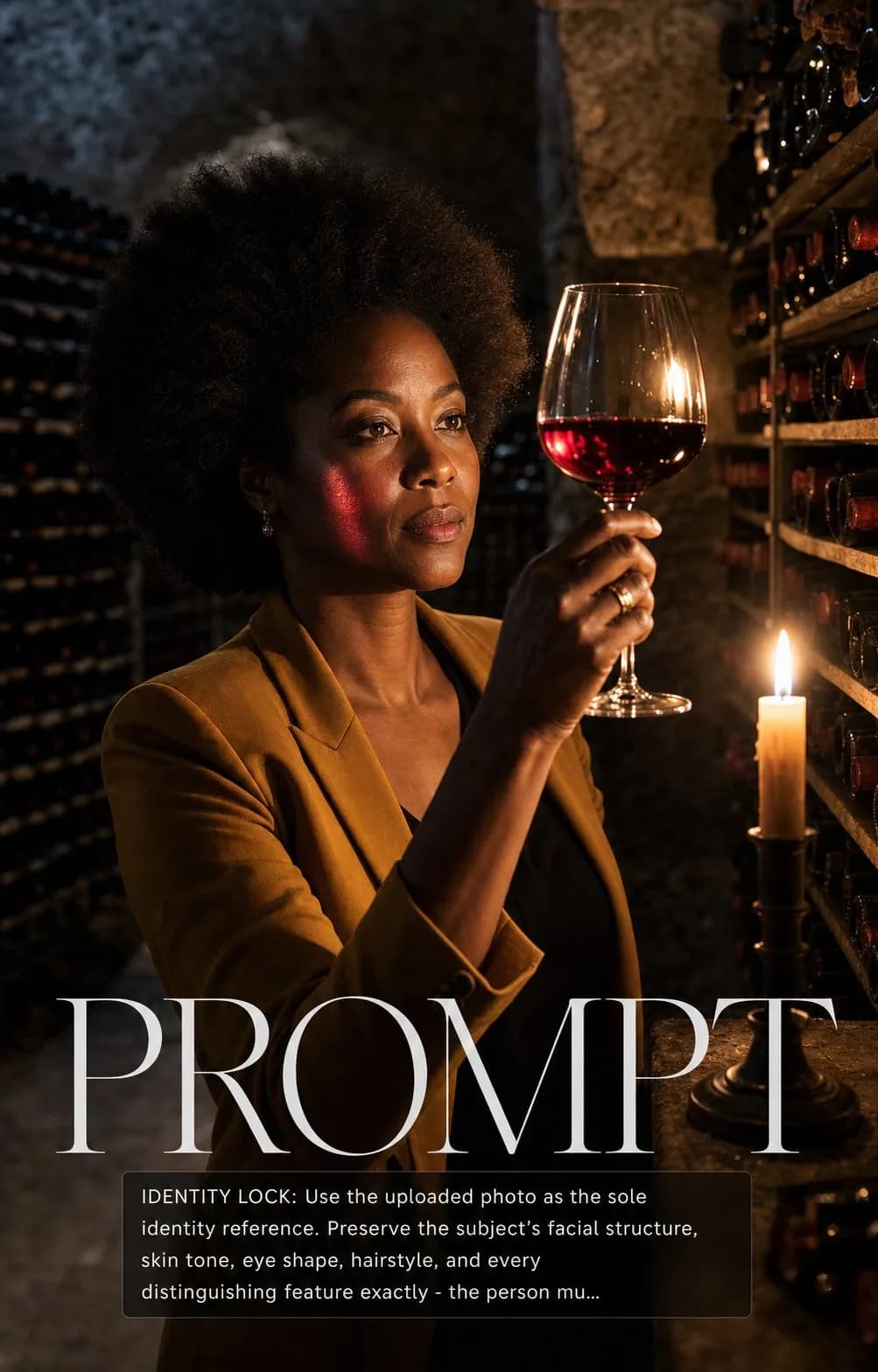
IDENTITY LOCK: Use the uploaded photo as the sole identity reference. Preserve the subject's facial structure, skin tone, eye shape, hairstyle, and every distinguishing feature exactly — the person must remain instantly recognizable. No beautification, no face reshaping, no expression change unless stated. SCENE: Subject as a master sommelier in an ancient wine cellar — stone walls, ceiling-high bottle racks stretching into darkness behind them, holding a glass of deep ruby wine up to a single candle to examine the clarity and color. The candlelight through the wine turns it to liquid garnet. PHYSICS & CRAFT: Single candle as primary light source — 1900K warm, highly directional, creating deep shadow across half the face while the wine glass, raised between candle and face, projects ruby-red transmitted light onto the cheek. The cellar behind is in deep cool 4000K ambient stone-cold temperature. The wine in the glass has realistic liquid physics — legs on the glass, the ruby color accurate to a Barolo. TECHNICAL EXECUTION: 85mm f/2.0, medium portrait, the wine glass held at eye height between subject and candle, the transmitted ruby light on the face the hero element, cellar racks in deep bokeh background. HARD CONSTRAINTS: The transmitted light through the wine onto the face must be physically accurate — the glass acts as a color gel. The candle flame must be real — no digital fire. Keep their clothing plus sommelier's tastevin if appropriate.
0 people have copied this prompt
Wine Sommelier Cellar Portrait is a photorealistic prompt for GPT Image 2, composed for a 4:5 image. No beautification, no face reshaping, no expression change unless stated.
No beautification, no face reshaping, no expression change unless stated.
Keep the prompt structure, then replace the main subject, action, or environment in "No beautification, no face reshaping, no expression change unless stated.".
Adjust one visual signal at a time, such as "85mm", "f/2.0", "bokeh", "ai image prompt", so you can identify which instruction changes the result.
Keep the focal subject prominent in the portrait frame while preserving enough background detail for feed and poster layouts.
Use one clear reference image and retain the identity-lock instructions when changing clothing, lighting, background, or camera direction.
Use direct natural-language edits after the first generation. State what must remain unchanged before describing the single element you want to revise.
Judge the result by believable materials, natural anatomy, coherent light direction, and a camera perspective that matches the scene.
Three simple steps to generate your AI image.
Click the "Copy Full Prompt" button above to copy the entire prompt text to your clipboard instantly.
Open your preferred image generator and paste the prompt into the text input. You're ready to create.
Hit generate and watch the magic happen. Tweak the prompt parameters to make it your own.