
Key instructions to preserve
No beautification, no face reshaping, no expression change unless stated.
GuardrailFull clothing-to-bronze translation is mandatory — no naked or toga-draped default.
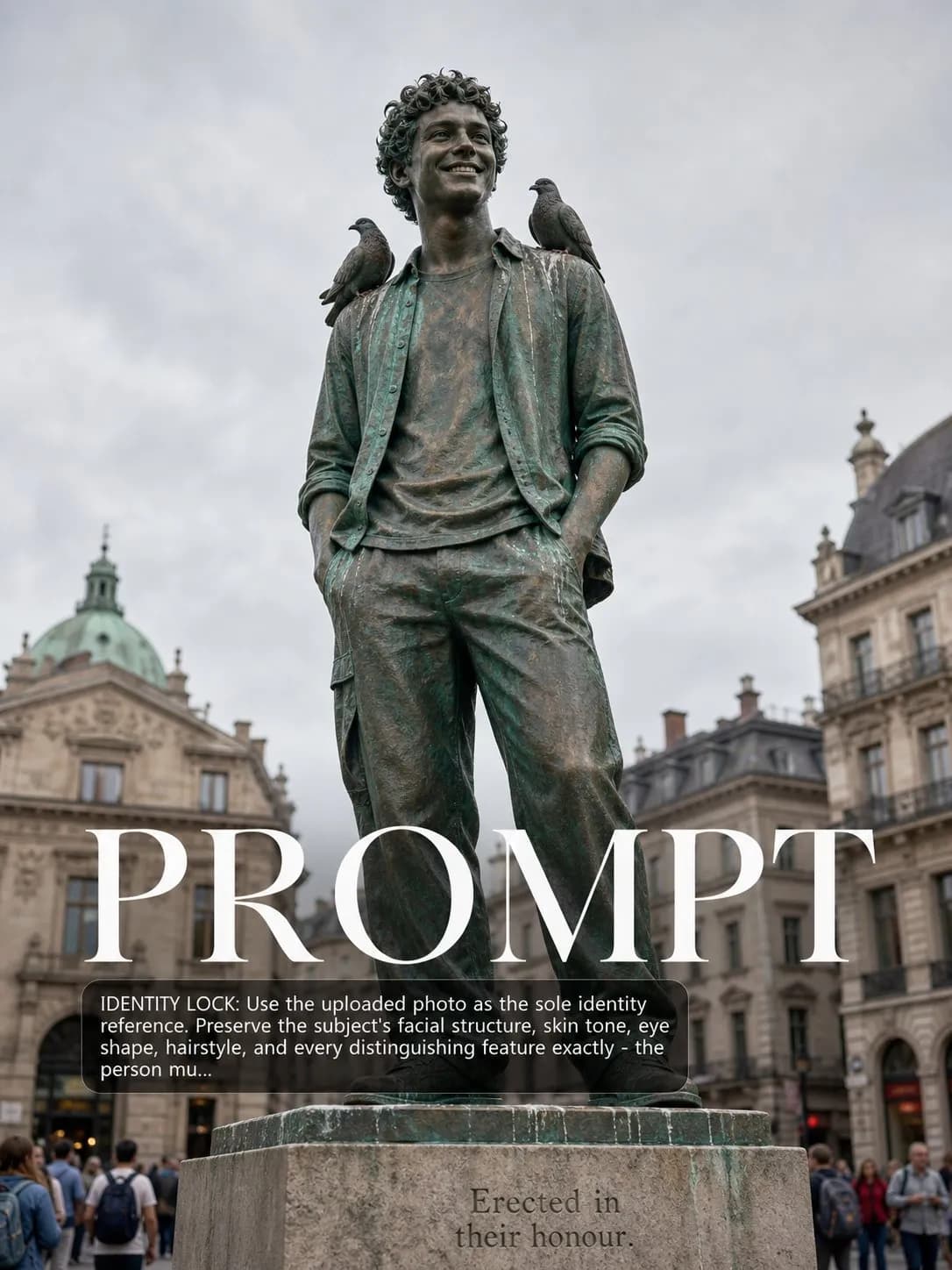
IDENTITY LOCK: Use the uploaded photo as the sole identity reference. Preserve the subject's facial structure, skin tone, eye shape, hairstyle, and every distinguishing feature exactly — the person must remain instantly recognizable. No beautification, no face reshaping, no expression change unless stated. SCENE: Subject transformed into a large patinated bronze public statue mounted on a tall stone pedestal in a grand European city square — pigeons perched on the shoulders, their current clothing faithfully translated into cast bronze. PHYSICS & CRAFT: Verdigris patina with realistic green oxidation pooling in low relief areas and warm bare bronze on high- contact edges. Hard overcast 6000K daylight with no dominant shadow direction. Bird droppings weathering on the shoulders and plinth top — earned realism. The pedestal bears a small carved inscription: 'Erected in their honour.' TECHNICAL EXECUTION: 35mm f/5.6 street level looking slightly up, tourists and city architecture softly bokeh'd in background, documentary photography style, slight wide-angle lens distortion from looking up. HARD CONSTRAINTS: Full clothing-to-bronze translation is mandatory — no naked or toga-draped default. No changes to the subject's pose unless a heroic standing pose is needed to work as a statue.
0 people have copied this prompt
Bronze Statue in City Square is a concept art prompt for GPT Image 2, composed for a 3:4 image. No beautification, no face reshaping, no expression change unless stated.
No beautification, no face reshaping, no expression change unless stated.
Keep the prompt structure, then replace the main subject, action, or environment in "No beautification, no face reshaping, no expression change unless stated.".
Adjust one visual signal at a time, such as "35mm", "f/5.6", "bokeh", "wide-angle", so you can identify which instruction changes the result.
Use the portrait frame for editorial-style compositions with enough surrounding context to establish the scene.
Use one clear reference image and retain the identity-lock instructions when changing clothing, lighting, background, or camera direction.
Use direct natural-language edits after the first generation. State what must remain unchanged before describing the single element you want to revise.
Judge the result by how clearly it communicates the intended concept art direction while keeping the subject, environment, and visual treatment consistent.
Three simple steps to generate your AI image.
Click the "Copy Full Prompt" button above to copy the entire prompt text to your clipboard instantly.
Open your preferred image generator and paste the prompt into the text input. You're ready to create.
Hit generate and watch the magic happen. Tweak the prompt parameters to make it your own.