
Key instructions to preserve
No beautification, no face reshaping, no expression change unless stated.
GuardrailDo not use generic Egyptian face templates.
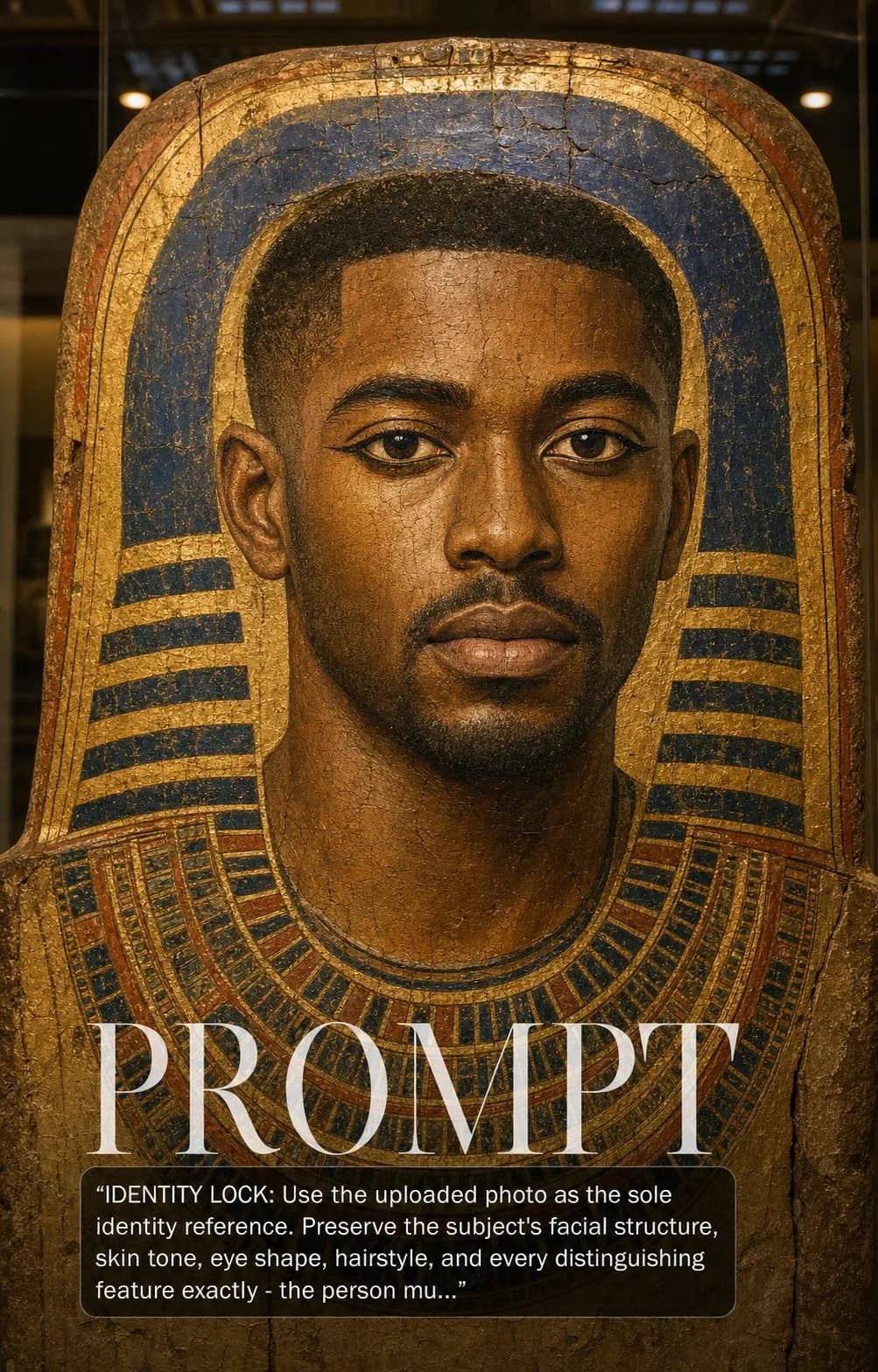
IDENTITY LOCK: Use the uploaded photo as the sole identity reference. Preserve the subject's facial structure, skin tone, eye shape, hairstyle, and every distinguishing feature exactly — the person must remain instantly recognizable. No beautification, no face reshaping, no expression change unless stated. SCENE: Subject's portrait rendered as the painted face panel of an Egyptian mummy sarcophagus — their likeness reproduced in the iconic flat frontal style of New Kingdom funerary art but with photorealistic paint and gilding, mounted in a museum vitrine under conservation lighting. PHYSICS & CRAFT: Aged lapis lazuli, gold leaf, and oxidized ochre pigments on cracked gesso ground. Face rendered with characteristic Egyptian stylization — frontal eyes on a three-quarter face — but the underlying facial identity must be unmistakably the subject. Vitrine glass reflects a faint museum ceiling. 3800K warm gallery spotlighting, deep shadow in sarcophagus recesses. TECHNICAL EXECUTION: 50mm macro lens feel, flat institutional photography angle slightly above horizontal, tight crop on the face panel, visible craquelure across the painted surface, gold leaf catching specular highlights. HARD CONSTRAINTS: Do not use generic Egyptian face templates. The face must be recognizably the uploaded person translated into this art style. No costume on the subject outside the sarcophagus frame.
0 people have copied this prompt
Egyptian Sarcophagus Portrait Panel is a concept art prompt for GPT Image 2, composed for a 4:5 image. No beautification, no face reshaping, no expression change unless stated.
No beautification, no face reshaping, no expression change unless stated.
Keep the prompt structure, then replace the main subject, action, or environment in "No beautification, no face reshaping, no expression change unless stated.".
Adjust one visual signal at a time, such as "50mm", "macro", "ai image prompt", "museum & gallery artifact", so you can identify which instruction changes the result.
Keep the focal subject prominent in the portrait frame while preserving enough background detail for feed and poster layouts.
Use one clear reference image and retain the identity-lock instructions when changing clothing, lighting, background, or camera direction.
Use direct natural-language edits after the first generation. State what must remain unchanged before describing the single element you want to revise.
Judge the result by how clearly it communicates the intended concept art direction while keeping the subject, environment, and visual treatment consistent.
Three simple steps to generate your AI image.
Click the "Copy Full Prompt" button above to copy the entire prompt text to your clipboard instantly.
Open your preferred image generator and paste the prompt into the text input. You're ready to create.
Hit generate and watch the magic happen. Tweak the prompt parameters to make it your own.