
Key instructions to preserve
No beautification, no face reshaping, no expression change unless stated.
GuardrailThe rock face formation must be unmistakably the subject.
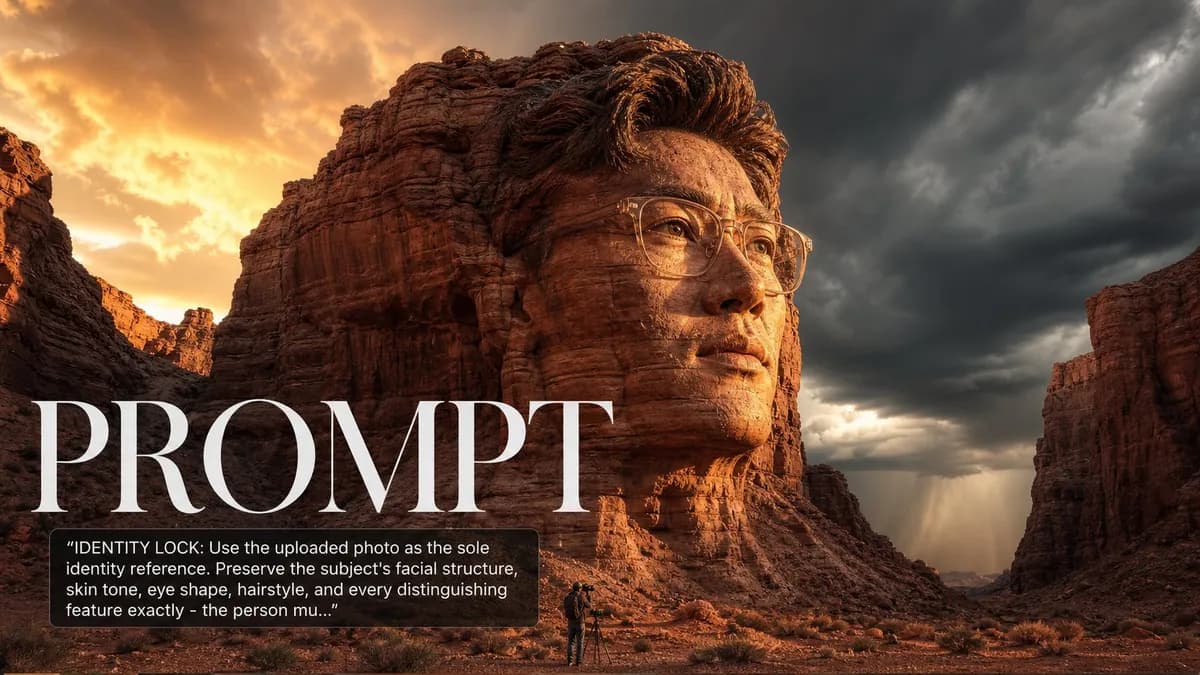
IDENTITY LOCK: Use the uploaded photo as the sole identity reference. Preserve the subject's facial structure, skin tone, eye shape, hairstyle, and every distinguishing feature exactly — the person must remain instantly recognizable. No beautification, no face reshaping, no expression change unless stated. SCENE: A massive natural sandstone rock formation in a canyon has, through millions of years of erosion, formed the uncanny likeness of the subject's face — presented as a genuine natural geological wonder, photographed by a nature documentary crew at golden hour with a dramatic storm rolling in from the right. PHYSICS & CRAFT: Red sandstone canyon geology — layered sedimentary strata, desert varnish streaks, fracture lines. The facial likeness emerges from natural erosion: shadow in eye sockets, a nose ridge of projecting rock, the mouth line a natural horizontal fracture. The resemblance is unmistakable and eerie. Golden hour 2700K light raking across the rock face from low left reveals every geological texture. TECHNICAL EXECUTION: 24mm f/11 documentary photography, the rock formation center frame, a human figure with camera equipment tiny at the base for scale, storm clouds building dramatically on the right, the canyon walls framing the sides. HARD CONSTRAINTS: The rock face formation must be unmistakably the subject. The geological textures must be physically plausible — no flat surfaces or obviously artificial carving. The scene must read as natural phenomenon, not man- made.
0 people have copied this prompt
Your Face on a Canyon Rock Formation is a concept art prompt for GPT Image 2, composed for a 16:9 image. No beautification, no face reshaping, no expression change unless stated.
No beautification, no face reshaping, no expression change unless stated.
Keep the prompt structure, then replace the main subject, action, or environment in "No beautification, no face reshaping, no expression change unless stated.".
Adjust one visual signal at a time, such as "24mm", "f/11", "golden hour", "ai image prompt", so you can identify which instruction changes the result.
Use the wide frame to establish the environment, place supporting details around the subject, and maintain a clear focal point.
Use one clear reference image and retain the identity-lock instructions when changing clothing, lighting, background, or camera direction.
Use direct natural-language edits after the first generation. State what must remain unchanged before describing the single element you want to revise.
Judge the result by how clearly it communicates the intended concept art direction while keeping the subject, environment, and visual treatment consistent.
Three simple steps to generate your AI image.
Click the "Copy Full Prompt" button above to copy the entire prompt text to your clipboard instantly.
Open your preferred image generator and paste the prompt into the text input. You're ready to create.
Hit generate and watch the magic happen. Tweak the prompt parameters to make it your own.