
15 AI Virtual Try-On Prompts: Change Clothes Without Changing the Person (2026)
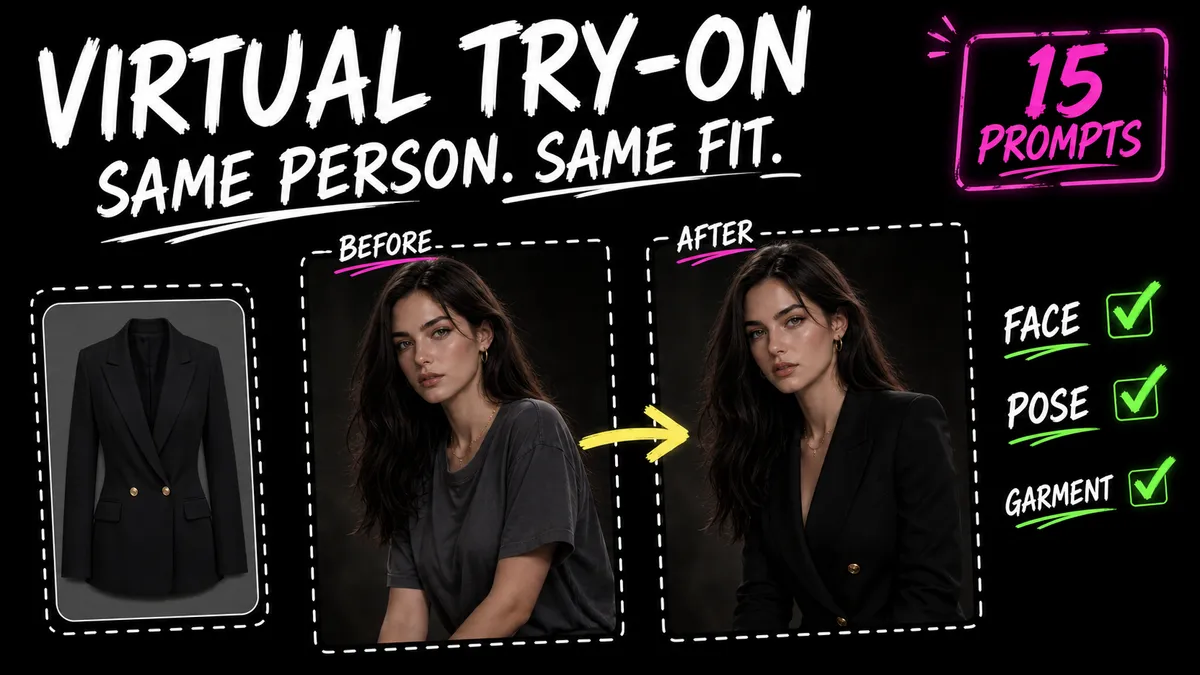
Use 15 AI virtual try-on prompts to change garments, colors, accessories, and styling while preserving identity, body proportions, and product details.
On this page 34 sections
Key takeaways
Use separate, clear photos of the person and garment, name which image supplies identity and which supplies clothing, then lock face, body, pose, hands, camera, garment construction, print, and logos. Change one item at a time and treat the result as a visualization—not proof of real-world fit.
Use 15 AI virtual try-on prompts to change garments, colors, accessories, and styling while preserving identity, body proportions, and product details.
AI virtual try-on prompts should begin with the real production decision, not a pile of style adjectives. This guide is written for fashion shoppers, stylists, ecommerce teams, creators, and apparel brands. The 15 templates below are designed to preview a garment or styling change while preserving the wearer and the product’s important details.
> Direct answer: Begin with a clear person photo plus a separate front-facing garment image whenever exact garment design matters. Define the single decision this image must communicate, explicitly protect the person’s identity, face, body proportions, pose, hands, skin, hair, camera, and background, plus garment silhouette, print, seams, closures, logos, and material, and judge the result against the source before it is published or used commercially.
TL;DR
Use separate, clear photos of the person and garment, name which image supplies identity and which supplies clothing, then lock face, body, pose, hands, camera, garment construction, print, and logos. Change one item at a time and treat the result as a visualization—not proof of real-world fit.
Why AI virtual try-on prompts need a dedicated workflow in 2026
For AI virtual try-on prompts, a visually attractive output can still be unusable when the system changes facts the viewer assumes are real. The critical risk in this topic is not simply a weak aesthetic; it is losing the person’s identity, face, body proportions, pose, hands, skin, hair, camera, and background, plus garment silhouette, print, seams, closures, logos, and material. A useful brief therefore separates the requested creative change from the evidence that must survive unchanged.
Current tools can follow natural-language edits and references, yet their own documentation still treats generation as iterative. For this task, that means planning around fabric drape that follows the pose, correct occlusion at arms and hair, believable contact, consistent light, and no warped anatomy. When a pixel, measurement, spelling, logo, or regulated statement must be exact, finish that element with a conventional editing, layout, vector, or measurement tool.
A five-part formula for AI virtual try-on prompts
Build each request in this order:
- Source for this task: state that you are providing a clear person photo plus a separate front-facing garment image whenever exact garment design matters.
- Useful outcome: describe how the result will help fashion shoppers, stylists, ecommerce teams, creators, and apparel brands.
- Truth locks: copy the non-negotiable list—the person’s identity, face, body proportions, pose, hands, skin, hair, camera, and background, plus garment silhouette, print, seams, closures, logos, and material.
- Visual behavior: require fabric drape that follows the pose, correct occlusion at arms and hair, believable contact, consistent light, and no warped anatomy.
- Final delivery: name the crop, safe areas, variation count, exclusions, and real publishing context.
This order makes omissions visible. If a requested detail is absent from the source and the brief, the generator must guess; in AI virtual try-on prompts, that guess can quietly become the most noticeable part of the image.
AI virtual try-on prompts preflight
Before opening a generator, collect and verify:
- a clear person photo plus a separate front-facing garment image whenever exact garment design matters;
- permission for every supplied likeness, product, artwork, room, or private location;
- the exact facts the viewer could reasonably interpret as true;
- the final aspect ratio and smallest display size;
- one primary visual decision for the first pass;
- a side-by-side review method for the person’s identity, face, body proportions, pose, hands, skin, hair, camera, and background, plus garment silhouette, print, seams, closures, logos, and material; and
- a non-generative fallback for precision typography, vectors, dimensions, or compliance details.
15 copy-ready AI virtual try-on prompts
1. Try on a blazer
Use the supplied reference images for this AI virtual try-on prompts task.

GOAL:
Replace only the current outer layer with the supplied blazer, preserving lapels, buttons, seams, fabric, and fit around the existing pose.

PRESERVE / REQUIRE:
- the person’s identity, face, body proportions, pose, hands, skin, hair, camera, and background, plus garment silhouette, print, seams, closures, logos, and material
- fabric drape that follows the pose, correct occlusion at arms and hair, believable contact, consistent light, and no warped anatomy
- the requested composition, original aspect ratio when editing, and no unrequested objects

Return one polished try on a blazer variation. Exclude watermarks, fake signatures, fabricated claims, and unreadable decorative text.
2. Try on a patterned dress
Use the supplied reference images for this AI virtual try-on prompts task.

GOAL:
Apply the supplied dress while keeping its print scale, color placement, neckline, sleeves, hem, and fabric character intact.

PRESERVE / REQUIRE:
- the person’s identity, face, body proportions, pose, hands, skin, hair, camera, and background, plus garment silhouette, print, seams, closures, logos, and material
- fabric drape that follows the pose, correct occlusion at arms and hair, believable contact, consistent light, and no warped anatomy
- the requested composition, original aspect ratio when editing, and no unrequested objects

Return one polished try on a patterned dress variation. Exclude watermarks, fake signatures, fabricated claims, and unreadable decorative text.
3. Change garment color
Use the supplied reference images for this AI virtual try-on prompts task.

GOAL:
Recolor only the shirt to the specified color while preserving material, wrinkles, seams, shadows, body, and every other item.

PRESERVE / REQUIRE:
- the person’s identity, face, body proportions, pose, hands, skin, hair, camera, and background, plus garment silhouette, print, seams, closures, logos, and material
- fabric drape that follows the pose, correct occlusion at arms and hair, believable contact, consistent light, and no warped anatomy
- the requested composition, original aspect ratio when editing, and no unrequested objects

Return one polished change garment color variation. Exclude watermarks, fake signatures, fabricated claims, and unreadable decorative text.
4. Swap footwear
Use the supplied reference images for this AI virtual try-on prompts task.

GOAL:
Replace only the visible shoes with the supplied pair, matching foot angle, scale, floor contact, shadows, and trouser occlusion.

PRESERVE / REQUIRE:
- the person’s identity, face, body proportions, pose, hands, skin, hair, camera, and background, plus garment silhouette, print, seams, closures, logos, and material
- fabric drape that follows the pose, correct occlusion at arms and hair, believable contact, consistent light, and no warped anatomy
- the requested composition, original aspect ratio when editing, and no unrequested objects

Return one polished swap footwear variation. Exclude watermarks, fake signatures, fabricated claims, and unreadable decorative text.
5. Add a coat
Use the supplied reference images for this AI virtual try-on prompts task.

GOAL:
Layer the supplied coat over the current outfit with realistic drape and occlusion while keeping pose, hands, face, and background unchanged.

PRESERVE / REQUIRE:
- the person’s identity, face, body proportions, pose, hands, skin, hair, camera, and background, plus garment silhouette, print, seams, closures, logos, and material
- fabric drape that follows the pose, correct occlusion at arms and hair, believable contact, consistent light, and no warped anatomy
- the requested composition, original aspect ratio when editing, and no unrequested objects

Return one polished add a coat variation. Exclude watermarks, fake signatures, fabricated claims, and unreadable decorative text.
6. Try a formal suit
Use the supplied reference images for this AI virtual try-on prompts task.

GOAL:
Apply a tailored two-piece suit in the supplied cut and fabric, preserving the person and avoiding body reshaping.

PRESERVE / REQUIRE:
- the person’s identity, face, body proportions, pose, hands, skin, hair, camera, and background, plus garment silhouette, print, seams, closures, logos, and material
- fabric drape that follows the pose, correct occlusion at arms and hair, believable contact, consistent light, and no warped anatomy
- the requested composition, original aspect ratio when editing, and no unrequested objects

Return one polished try a formal suit variation. Exclude watermarks, fake signatures, fabricated claims, and unreadable decorative text.
7. Try activewear
Use the supplied reference images for this AI virtual try-on prompts task.

GOAL:
Replace only the outfit with the specified activewear set, preserving pose, proportions, logos, panels, and fabric stretch.

PRESERVE / REQUIRE:
- the person’s identity, face, body proportions, pose, hands, skin, hair, camera, and background, plus garment silhouette, print, seams, closures, logos, and material
- fabric drape that follows the pose, correct occlusion at arms and hair, believable contact, consistent light, and no warped anatomy
- the requested composition, original aspect ratio when editing, and no unrequested objects

Return one polished try activewear variation. Exclude watermarks, fake signatures, fabricated claims, and unreadable decorative text.
8. Add a scarf
Use the supplied reference images for this AI virtual try-on prompts task.

GOAL:
Add only the supplied scarf with realistic folds and contact around the neck, without changing hair, face, shoulders, or shirt.

PRESERVE / REQUIRE:
- the person’s identity, face, body proportions, pose, hands, skin, hair, camera, and background, plus garment silhouette, print, seams, closures, logos, and material
- fabric drape that follows the pose, correct occlusion at arms and hair, believable contact, consistent light, and no warped anatomy
- the requested composition, original aspect ratio when editing, and no unrequested objects

Return one polished add a scarf variation. Exclude watermarks, fake signatures, fabricated claims, and unreadable decorative text.
9. Try a handbag
Use the supplied reference images for this AI virtual try-on prompts task.

GOAL:
Place the supplied bag naturally in the visible hand or on the shoulder, preserving hardware, shape, logo, scale, grip, and shadows.

PRESERVE / REQUIRE:
- the person’s identity, face, body proportions, pose, hands, skin, hair, camera, and background, plus garment silhouette, print, seams, closures, logos, and material
- fabric drape that follows the pose, correct occlusion at arms and hair, believable contact, consistent light, and no warped anatomy
- the requested composition, original aspect ratio when editing, and no unrequested objects

Return one polished try a handbag variation. Exclude watermarks, fake signatures, fabricated claims, and unreadable decorative text.
10. Change sleeve length
Use the supplied reference images for this AI virtual try-on prompts task.

GOAL:
Change only the shirt sleeves from long to rolled elbow length while preserving shirt design, body, hands, and lighting.

PRESERVE / REQUIRE:
- the person’s identity, face, body proportions, pose, hands, skin, hair, camera, and background, plus garment silhouette, print, seams, closures, logos, and material
- fabric drape that follows the pose, correct occlusion at arms and hair, believable contact, consistent light, and no warped anatomy
- the requested composition, original aspect ratio when editing, and no unrequested objects

Return one polished change sleeve length variation. Exclude watermarks, fake signatures, fabricated claims, and unreadable decorative text.
11. Style one outfit three ways
Use the supplied reference images for this AI virtual try-on prompts task.

GOAL:
Create three separate outputs using the same base outfit with only accessories and outer layer changed between casual, work, and evening.

PRESERVE / REQUIRE:
- the person’s identity, face, body proportions, pose, hands, skin, hair, camera, and background, plus garment silhouette, print, seams, closures, logos, and material
- fabric drape that follows the pose, correct occlusion at arms and hair, believable contact, consistent light, and no warped anatomy
- the requested composition, original aspect ratio when editing, and no unrequested objects

Return one polished style one outfit three ways variation. Exclude watermarks, fake signatures, fabricated claims, and unreadable decorative text.
12. Modest styling variation
Use the supplied reference images for this AI virtual try-on prompts task.

GOAL:
Add the requested coverage layer while preserving the underlying color story, person, pose, and realistic fabric interaction.

PRESERVE / REQUIRE:
- the person’s identity, face, body proportions, pose, hands, skin, hair, camera, and background, plus garment silhouette, print, seams, closures, logos, and material
- fabric drape that follows the pose, correct occlusion at arms and hair, believable contact, consistent light, and no warped anatomy
- the requested composition, original aspect ratio when editing, and no unrequested objects

Return one polished modest styling variation variation. Exclude watermarks, fake signatures, fabricated claims, and unreadable decorative text.
13. Maternity styling concept
Use the supplied reference images for this AI virtual try-on prompts task.

GOAL:
Preview the supplied maternity garment without changing the person’s face or making unsupported body assumptions beyond the provided reference.

PRESERVE / REQUIRE:
- the person’s identity, face, body proportions, pose, hands, skin, hair, camera, and background, plus garment silhouette, print, seams, closures, logos, and material
- fabric drape that follows the pose, correct occlusion at arms and hair, believable contact, consistent light, and no warped anatomy
- the requested composition, original aspect ratio when editing, and no unrequested objects

Return one polished maternity styling concept variation. Exclude watermarks, fake signatures, fabricated claims, and unreadable decorative text.
14. Uniform visualization
Use the supplied reference images for this AI virtual try-on prompts task.

GOAL:
Apply the supplied legitimate uniform design while preserving insignia and construction; do not invent rank, credentials, or authority.

PRESERVE / REQUIRE:
- the person’s identity, face, body proportions, pose, hands, skin, hair, camera, and background, plus garment silhouette, print, seams, closures, logos, and material
- fabric drape that follows the pose, correct occlusion at arms and hair, believable contact, consistent light, and no warped anatomy
- the requested composition, original aspect ratio when editing, and no unrequested objects

Return one polished uniform visualization variation. Exclude watermarks, fake signatures, fabricated claims, and unreadable decorative text.
15. Catalog consistency set
Use the supplied reference images for this AI virtual try-on prompts task.

GOAL:
Keep one model, pose, crop, background, and lighting identical while changing only one supplied garment per output.

PRESERVE / REQUIRE:
- the person’s identity, face, body proportions, pose, hands, skin, hair, camera, and background, plus garment silhouette, print, seams, closures, logos, and material
- fabric drape that follows the pose, correct occlusion at arms and hair, believable contact, consistent light, and no warped anatomy
- the requested composition, original aspect ratio when editing, and no unrequested objects

Return one polished catalog consistency set variation. Exclude watermarks, fake signatures, fabricated claims, and unreadable decorative text.
A production workflow built for AI virtual try-on prompts
1. Archive the evidence before editing
Keep a clear person photo plus a separate front-facing garment image whenever exact garment design matters untouched and give it a clear filename. In a separate note, record the person’s identity, face, body proportions, pose, hands, skin, hair, camera, and background, plus garment silhouette, print, seams, closures, logos, and material. This turns subjective review into a comparison task. The preservation pattern in AI face consistency guide can be adapted to the exact source used here.
2. Test the clearest use case first
Start with try on a blazer, try on a patterned dress, change garment color. Choose the example closest to the real deliverable, then change only the scene or presentation requested by that template. Do not combine several templates until one baseline output passes the truth-lock review.
3. Review the physics that make this result believable
For AI virtual try-on prompts, inspect fabric drape that follows the pose, correct occlusion at arms and hair, believable contact, consistent light, and no warped anatomy. Zoomed-in polish cannot rescue a wrong silhouette, implausible contact point, changed face, false room geometry, or misleading product relationship. Reject structural errors before spending time on color and styling.
4. Finish exact communication outside the generator
Names, prices, measurements, credentials, ingredients, logos, legal copy, and small labels deserve a separate verification pass. Generate a clean composition and enough negative space, then place critical wording in a layout tool where spelling, contrast, and alignment can be controlled.
5. Stress-test a second delivery context
Use style one outfit three ways, modest styling variation, maternity styling concept as reminders that the same concept may be viewed in another crop, device, audience, or channel. Inspect the full-resolution file for defects, then inspect the actual card, thumbnail, feed, listing, print, or profile size for hierarchy and legibility.
6. Preserve the decision trail
For every accepted AI virtual try-on prompts result, save the source filename, exact prompt, model, date, settings, chosen output, rejected issue, and manual corrections. That record makes a later update reproducible instead of forcing the team to reverse-engineer an image.
AI virtual try-on prompts: common failures and targeted fixes
| Failure in this task | Likely cause | Better correction |
|---|---|---|
| The result no longer preserves the person’s identity, face, body proportions, pose, hands, skin, hair, camera, and background, plus garment silhouette, print, seams, closures, logos, and material | The brief described the new look but never made the source facts non-negotiable | Paste the truth-lock sentence before the style request and compare every output side by side |
| The concept does not help fashion shoppers, stylists, ecommerce teams, creators, and apparel brands | The model received visual adjectives without a real viewer or decision | State the audience, placement, message, and one action the visual should support |
| The scene feels physically wrong | The request omitted fabric drape that follows the pose, correct occlusion at arms and hair, believable contact, consistent light, and no warped anatomy | Add camera, scale, light, contact, material, and perspective constraints that apply to this source |
| A required label or statement is nearly correct | Lettering was generated as image texture rather than typeset information | Reserve a clean text zone and place verified wording in a layout editor |
| Later versions drift away from the approved source | A flawed generated output was repeatedly used as the next reference | Return to the last verified source and apply one narrowly described change |
| The output looks impressive but implies something untrue | Creative freedom was not separated from factual presentation | Remove the unsupported cue and label generated, reconstructed, staged, or illustrative content when relevant |
Internal resources for this workflow
- AI face consistency guide
- GPT Image 2 controlled edit prompts
- high-fashion campaign prompt
- black-label watch campaign
Each link above addresses a nearby task in the AI virtual try-on prompts process: source preservation, a model-specific workflow, or a ready-made prompt example. Use the relevant link at the point where the reader needs it instead of treating internal links as an unrelated recommendation block.
Rights and truthful use for AI virtual try-on prompts
Get consent for every person shown. Do not alter bodies deceptively, claim sizing accuracy, or imply that a generated garment preview is a photograph of actual fit.
Before release, a human reviewer should check permissions, licensing, trademarks, accessibility, representation, and every factual implication specific to preview a garment or styling change while preserving the wearer and the product’s important details. The model can produce a draft; responsibility for the published claim remains with the person or organization using it.
Final AI virtual try-on prompts quality check
- Does the image clearly preview a garment or styling change while preserving the wearer and the product’s important details?
- Does it still preserve the person’s identity, face, body proportions, pose, hands, skin, hair, camera, and background, plus garment silhouette, print, seams, closures, logos, and material?
- Does the rendering show fabric drape that follows the pose, correct occlusion at arms and hair, believable contact, consistent light, and no warped anatomy?
- Are names, labels, numbers, logos, credentials, prices, and claims verified?
- Are key edges and repeated details intact at 100% zoom?
- Does the hierarchy survive the real aspect ratio and smallest display size?
- Would a reasonable viewer understand what is generated, edited, staged, restored, or illustrative?
- Has the rights holder and a relevant human reviewer approved the final use?
Final answer
Effective AI virtual try-on prompts make the requested change easy to see and the protected facts easy to audit. Pick the closest template, replace every placeholder with the real source and delivery details, run one focused generation, and reject any output that weakens the truth locks. That disciplined loop is more reusable than chasing a longer list of aesthetic adjectives.
Frequently asked questions
What should a good AI virtual try-on prompt include?
Which AI image model should I use for AI virtual try-on prompts?
Why does the AI change details I did not ask it to change?
Should I generate important text inside the image?
How many variations should I create?
Can I use the generated result commercially?
Sources and further reading
- OpenAI Developers: GPT Image 2 model documentation — https://developers.openai.com/api/docs/models/gpt-image-2
- OpenAI Developers: Image generation and editing guide — https://developers.openai.com/api/docs/guides/image-generation
- Google AI for Developers: Gemini image generation and editing — https://ai.google.dev/gemini-api/docs/image-generation
- Adobe: The Ultimate Guide to Firefly 2026 — https://www.adobe.com/content/dam/cc/tnt/emea/intl1202/Firefly_Prompt_Guide_2026_EN.pdf
- FEAT: Fashion Editing and Try-On from Any Design (CVPR 2026) — https://arxiv.org/abs/2605.02393
- PROMO: Promptable Outfitting for Efficient High-Fidelity Virtual Try-On (2026) — https://arxiv.org/abs/2603.11675