
15 AI Food Photography Prompts for Menus, Restaurants, and Recipe Creators (2026)
Use 15 AI food-photography prompts for menus, delivery apps, recipes, social posts, beverages, desserts, and restaurant campaigns.
On this page 34 sections
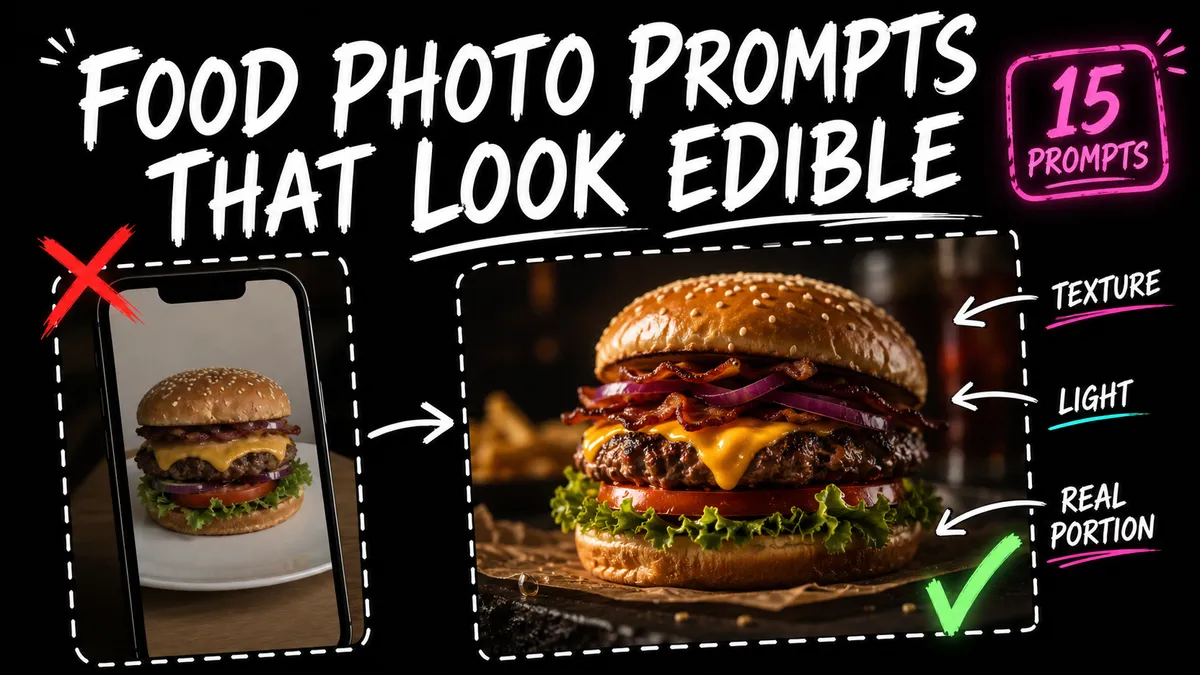
Key takeaways
Describe the exact dish before the mood: ingredients, portion, plating, surface, camera angle, lens feel, light, texture, and final crop. Keep menu images truthful to what customers receive. Generate platform-specific variations separately and inspect hands, utensils, garnish, steam, labels, and repeated food patterns.
Use 15 AI food-photography prompts for menus, delivery apps, recipes, social posts, beverages, desserts, and restaurant campaigns.
AI food photography prompts should begin with the real production decision, not a pile of style adjectives. This guide is written for restaurants, food bloggers, delivery brands, recipe creators, and hospitality marketers. The 15 templates below are designed to create appetizing food visuals with deliberate styling, camera angle, texture, and platform crop.
> Direct answer: Begin with an accurate dish description or a clear reference photo showing the real ingredients, portion, plating, and brand presentation. Define the single decision this image must communicate, explicitly protect the actual dish type, ingredients, portion, plating, container, garnish, brand marks, and any supplied product packaging, and judge the result against the source before it is published or used commercially.
TL;DR
Describe the exact dish before the mood: ingredients, portion, plating, surface, camera angle, lens feel, light, texture, and final crop. Keep menu images truthful to what customers receive. Generate platform-specific variations separately and inspect hands, utensils, garnish, steam, labels, and repeated food patterns.
Why AI food photography prompts need a dedicated workflow in 2026
For AI food photography prompts, a visually attractive output can still be unusable when the system changes facts the viewer assumes are real. The critical risk in this topic is not simply a weak aesthetic; it is losing the actual dish type, ingredients, portion, plating, container, garnish, brand marks, and any supplied product packaging. A useful brief therefore separates the requested creative change from the evidence that must survive unchanged.
Current tools can follow natural-language edits and references, yet their own documentation still treats generation as iterative. For this task, that means planning around believable food texture, moisture, steam only when appropriate, natural shadows, realistic glass and cutlery reflections, and clean but not plastic-looking styling. When a pixel, measurement, spelling, logo, or regulated statement must be exact, finish that element with a conventional editing, layout, vector, or measurement tool.
A five-part formula for AI food photography prompts
Build each request in this order:
- Source for this task: state that you are providing an accurate dish description or a clear reference photo showing the real ingredients, portion, plating, and brand presentation.
- Useful outcome: describe how the result will help restaurants, food bloggers, delivery brands, recipe creators, and hospitality marketers.
- Truth locks: copy the non-negotiable list—the actual dish type, ingredients, portion, plating, container, garnish, brand marks, and any supplied product packaging.
- Visual behavior: require believable food texture, moisture, steam only when appropriate, natural shadows, realistic glass and cutlery reflections, and clean but not plastic-looking styling.
- Final delivery: name the crop, safe areas, variation count, exclusions, and real publishing context.
This order makes omissions visible. If a requested detail is absent from the source and the brief, the generator must guess; in AI food photography prompts, that guess can quietly become the most noticeable part of the image.
AI food photography prompts preflight
Before opening a generator, collect and verify:
- an accurate dish description or a clear reference photo showing the real ingredients, portion, plating, and brand presentation;
- permission for every supplied likeness, product, artwork, room, or private location;
- the exact facts the viewer could reasonably interpret as true;
- the final aspect ratio and smallest display size;
- one primary visual decision for the first pass;
- a side-by-side review method for the actual dish type, ingredients, portion, plating, container, garnish, brand marks, and any supplied product packaging; and
- a non-generative fallback for precision typography, vectors, dimensions, or compliance details.
15 copy-ready AI food photography prompts
1. Restaurant hero dish
Use the supplied reference image for this AI food photography prompts task.

GOAL:
Create an appetizing three-quarter hero photograph of the exact dish with soft directional light, visible texture, and restrained garnish.

PRESERVE / REQUIRE:
- the actual dish type, ingredients, portion, plating, container, garnish, brand marks, and any supplied product packaging
- believable food texture, moisture, steam only when appropriate, natural shadows, realistic glass and cutlery reflections, and clean but not plastic-looking styling
- the requested composition, original aspect ratio when editing, and no unrequested objects

Return one polished restaurant hero dish variation. Exclude watermarks, fake signatures, fabricated claims, and unreadable decorative text.
2. Delivery-app menu image
Use the supplied reference image for this AI food photography prompts task.

GOAL:
Create a clean centered top-down or 45-degree menu image on a simple background with truthful portion and container.

PRESERVE / REQUIRE:
- the actual dish type, ingredients, portion, plating, container, garnish, brand marks, and any supplied product packaging
- believable food texture, moisture, steam only when appropriate, natural shadows, realistic glass and cutlery reflections, and clean but not plastic-looking styling
- the requested composition, original aspect ratio when editing, and no unrequested objects

Return one polished delivery-app menu image variation. Exclude watermarks, fake signatures, fabricated claims, and unreadable decorative text.
3. Burger campaign
Use the supplied reference image for this AI food photography prompts task.

GOAL:
Show the exact ingredient stack clearly with realistic bun texture, controlled sauce, natural shadows, and no impossible floating layers.

PRESERVE / REQUIRE:
- the actual dish type, ingredients, portion, plating, container, garnish, brand marks, and any supplied product packaging
- believable food texture, moisture, steam only when appropriate, natural shadows, realistic glass and cutlery reflections, and clean but not plastic-looking styling
- the requested composition, original aspect ratio when editing, and no unrequested objects

Return one polished burger campaign variation. Exclude watermarks, fake signatures, fabricated claims, and unreadable decorative text.
4. Pizza close-up
Use the supplied reference image for this AI food photography prompts task.

GOAL:
Feature one whole pizza and one lifted slice with believable cheese behavior, crisp crust detail, and accurate toppings.

PRESERVE / REQUIRE:
- the actual dish type, ingredients, portion, plating, container, garnish, brand marks, and any supplied product packaging
- believable food texture, moisture, steam only when appropriate, natural shadows, realistic glass and cutlery reflections, and clean but not plastic-looking styling
- the requested composition, original aspect ratio when editing, and no unrequested objects

Return one polished pizza close-up variation. Exclude watermarks, fake signatures, fabricated claims, and unreadable decorative text.
5. Fine-dining plate
Use the supplied reference image for this AI food photography prompts task.

GOAL:
Use refined negative space, precise plating, soft side light, and realistic sauce and garnish without oversized decorative elements.

PRESERVE / REQUIRE:
- the actual dish type, ingredients, portion, plating, container, garnish, brand marks, and any supplied product packaging
- believable food texture, moisture, steam only when appropriate, natural shadows, realistic glass and cutlery reflections, and clean but not plastic-looking styling
- the requested composition, original aspect ratio when editing, and no unrequested objects

Return one polished fine-dining plate variation. Exclude watermarks, fake signatures, fabricated claims, and unreadable decorative text.
6. Coffee beverage
Use the supplied reference image for this AI food photography prompts task.

GOAL:
Show the exact cup and drink with natural crema or foam, soft café light, realistic steam, and clean tabletop texture.

PRESERVE / REQUIRE:
- the actual dish type, ingredients, portion, plating, container, garnish, brand marks, and any supplied product packaging
- believable food texture, moisture, steam only when appropriate, natural shadows, realistic glass and cutlery reflections, and clean but not plastic-looking styling
- the requested composition, original aspect ratio when editing, and no unrequested objects

Return one polished coffee beverage variation. Exclude watermarks, fake signatures, fabricated claims, and unreadable decorative text.
7. Cold beverage splash
Use the supplied reference image for this AI food photography prompts task.

GOAL:
Create a controlled commercial drink image with accurate bottle or can geometry, condensation, ice, and a believable small splash.

PRESERVE / REQUIRE:
- the actual dish type, ingredients, portion, plating, container, garnish, brand marks, and any supplied product packaging
- believable food texture, moisture, steam only when appropriate, natural shadows, realistic glass and cutlery reflections, and clean but not plastic-looking styling
- the requested composition, original aspect ratio when editing, and no unrequested objects

Return one polished cold beverage splash variation. Exclude watermarks, fake signatures, fabricated claims, and unreadable decorative text.
8. Bakery product
Use the supplied reference image for this AI food photography prompts task.

GOAL:
Show fresh pastry layers, crumbs, subtle glaze, warm window light, and simple paper or tray presentation.

PRESERVE / REQUIRE:
- the actual dish type, ingredients, portion, plating, container, garnish, brand marks, and any supplied product packaging
- believable food texture, moisture, steam only when appropriate, natural shadows, realistic glass and cutlery reflections, and clean but not plastic-looking styling
- the requested composition, original aspect ratio when editing, and no unrequested objects

Return one polished bakery product variation. Exclude watermarks, fake signatures, fabricated claims, and unreadable decorative text.
9. Dessert editorial
Use the supplied reference image for this AI food photography prompts task.

GOAL:
Create a premium close-up highlighting texture and layers with restrained highlights and an elegant dark or neutral surface.

PRESERVE / REQUIRE:
- the actual dish type, ingredients, portion, plating, container, garnish, brand marks, and any supplied product packaging
- believable food texture, moisture, steam only when appropriate, natural shadows, realistic glass and cutlery reflections, and clean but not plastic-looking styling
- the requested composition, original aspect ratio when editing, and no unrequested objects

Return one polished dessert editorial variation. Exclude watermarks, fake signatures, fabricated claims, and unreadable decorative text.
10. Healthy bowl
Use the supplied reference image for this AI food photography prompts task.

GOAL:
Show all named ingredients clearly separated at truthful quantities with natural color and soft overhead light.

PRESERVE / REQUIRE:
- the actual dish type, ingredients, portion, plating, container, garnish, brand marks, and any supplied product packaging
- believable food texture, moisture, steam only when appropriate, natural shadows, realistic glass and cutlery reflections, and clean but not plastic-looking styling
- the requested composition, original aspect ratio when editing, and no unrequested objects

Return one polished healthy bowl variation. Exclude watermarks, fake signatures, fabricated claims, and unreadable decorative text.
11. Recipe step image
Use the supplied reference image for this AI food photography prompts task.

GOAL:
Create a clean instructional overhead frame showing the specified stage, tools, and ingredients without adding later-step results.

PRESERVE / REQUIRE:
- the actual dish type, ingredients, portion, plating, container, garnish, brand marks, and any supplied product packaging
- believable food texture, moisture, steam only when appropriate, natural shadows, realistic glass and cutlery reflections, and clean but not plastic-looking styling
- the requested composition, original aspect ratio when editing, and no unrequested objects

Return one polished recipe step image variation. Exclude watermarks, fake signatures, fabricated claims, and unreadable decorative text.
12. Chef action scene
Use the supplied reference image for this AI food photography prompts task.

GOAL:
Show only the supplied cooking action with believable hands, utensils, heat, and kitchen background while keeping the dish central.

PRESERVE / REQUIRE:
- the actual dish type, ingredients, portion, plating, container, garnish, brand marks, and any supplied product packaging
- believable food texture, moisture, steam only when appropriate, natural shadows, realistic glass and cutlery reflections, and clean but not plastic-looking styling
- the requested composition, original aspect ratio when editing, and no unrequested objects

Return one polished chef action scene variation. Exclude watermarks, fake signatures, fabricated claims, and unreadable decorative text.
13. Seasonal restaurant campaign
Use the supplied reference image for this AI food photography prompts task.

GOAL:
Place the real dish in a restrained seasonal setting without changing ingredients, portion, plate, or restaurant identity.

PRESERVE / REQUIRE:
- the actual dish type, ingredients, portion, plating, container, garnish, brand marks, and any supplied product packaging
- believable food texture, moisture, steam only when appropriate, natural shadows, realistic glass and cutlery reflections, and clean but not plastic-looking styling
- the requested composition, original aspect ratio when editing, and no unrequested objects

Return one polished seasonal restaurant campaign variation. Exclude watermarks, fake signatures, fabricated claims, and unreadable decorative text.
14. Packaging plus prepared food
Use the supplied reference image for this AI food photography prompts task.

GOAL:
Show the exact branded package beside the truthful prepared product, preserving every label and proportion.

PRESERVE / REQUIRE:
- the actual dish type, ingredients, portion, plating, container, garnish, brand marks, and any supplied product packaging
- believable food texture, moisture, steam only when appropriate, natural shadows, realistic glass and cutlery reflections, and clean but not plastic-looking styling
- the requested composition, original aspect ratio when editing, and no unrequested objects

Return one polished packaging plus prepared food variation. Exclude watermarks, fake signatures, fabricated claims, and unreadable decorative text.
15. Consistent menu set
Use the supplied reference image for this AI food photography prompts task.

GOAL:
Use identical background, camera height, crop, light direction, plate scale, and color treatment across multiple dishes.

PRESERVE / REQUIRE:
- the actual dish type, ingredients, portion, plating, container, garnish, brand marks, and any supplied product packaging
- believable food texture, moisture, steam only when appropriate, natural shadows, realistic glass and cutlery reflections, and clean but not plastic-looking styling
- the requested composition, original aspect ratio when editing, and no unrequested objects

Return one polished consistent menu set variation. Exclude watermarks, fake signatures, fabricated claims, and unreadable decorative text.
A production workflow built for AI food photography prompts
1. Archive the evidence before editing
Keep an accurate dish description or a clear reference photo showing the real ingredients, portion, plating, and brand presentation untouched and give it a clear filename. In a separate note, record the actual dish type, ingredients, portion, plating, container, garnish, brand marks, and any supplied product packaging. This turns subjective review into a comparison task. The preservation pattern in AI product photography guide can be adapted to the exact source used here.
2. Test the clearest use case first
Start with restaurant hero dish, delivery-app menu image, burger campaign. Choose the example closest to the real deliverable, then change only the scene or presentation requested by that template. Do not combine several templates until one baseline output passes the truth-lock review.
3. Review the physics that make this result believable
For AI food photography prompts, inspect believable food texture, moisture, steam only when appropriate, natural shadows, realistic glass and cutlery reflections, and clean but not plastic-looking styling. Zoomed-in polish cannot rescue a wrong silhouette, implausible contact point, changed face, false room geometry, or misleading product relationship. Reject structural errors before spending time on color and styling.
4. Finish exact communication outside the generator
Names, prices, measurements, credentials, ingredients, logos, legal copy, and small labels deserve a separate verification pass. Generate a clean composition and enough negative space, then place critical wording in a layout tool where spelling, contrast, and alignment can be controlled.
5. Stress-test a second delivery context
Use recipe step image, chef action scene, seasonal restaurant campaign as reminders that the same concept may be viewed in another crop, device, audience, or channel. Inspect the full-resolution file for defects, then inspect the actual card, thumbnail, feed, listing, print, or profile size for hierarchy and legibility.
6. Preserve the decision trail
For every accepted AI food photography prompts result, save the source filename, exact prompt, model, date, settings, chosen output, rejected issue, and manual corrections. That record makes a later update reproducible instead of forcing the team to reverse-engineer an image.
AI food photography prompts: common failures and targeted fixes
| Failure in this task | Likely cause | Better correction |
|---|---|---|
| The result no longer preserves the actual dish type, ingredients, portion, plating, container, garnish, brand marks, and any supplied product packaging | The brief described the new look but never made the source facts non-negotiable | Paste the truth-lock sentence before the style request and compare every output side by side |
| The concept does not help restaurants, food bloggers, delivery brands, recipe creators, and hospitality marketers | The model received visual adjectives without a real viewer or decision | State the audience, placement, message, and one action the visual should support |
| The scene feels physically wrong | The request omitted believable food texture, moisture, steam only when appropriate, natural shadows, realistic glass and cutlery reflections, and clean but not plastic-looking styling | Add camera, scale, light, contact, material, and perspective constraints that apply to this source |
| A required label or statement is nearly correct | Lettering was generated as image texture rather than typeset information | Reserve a clean text zone and place verified wording in a layout editor |
| Later versions drift away from the approved source | A flawed generated output was repeatedly used as the next reference | Return to the last verified source and apply one narrowly described change |
| The output looks impressive but implies something untrue | Creative freedom was not separated from factual presentation | Remove the unsupported cue and label generated, reconstructed, staged, or illustrative content when relevant |
Internal resources for this workflow
- AI product photography guide
- GPT Image 2 prompt guide
- luxury perfume product composition
- wedding and event color grade
Each link above addresses a nearby task in the AI food photography prompts process: source preservation, a model-specific workflow, or a ready-made prompt example. Use the relevant link at the point where the reader needs it instead of treating internal links as an unrelated recommendation block.
Rights and truthful use for AI food photography prompts
Do not materially misrepresent portions, ingredients, packaging, or preparation. Use generated images as concepts unless the served product genuinely matches the visual.
Before release, a human reviewer should check permissions, licensing, trademarks, accessibility, representation, and every factual implication specific to create appetizing food visuals with deliberate styling, camera angle, texture, and platform crop. The model can produce a draft; responsibility for the published claim remains with the person or organization using it.
Final AI food photography prompts quality check
- Does the image clearly create appetizing food visuals with deliberate styling, camera angle, texture, and platform crop?
- Does it still preserve the actual dish type, ingredients, portion, plating, container, garnish, brand marks, and any supplied product packaging?
- Does the rendering show believable food texture, moisture, steam only when appropriate, natural shadows, realistic glass and cutlery reflections, and clean but not plastic-looking styling?
- Are names, labels, numbers, logos, credentials, prices, and claims verified?
- Are key edges and repeated details intact at 100% zoom?
- Does the hierarchy survive the real aspect ratio and smallest display size?
- Would a reasonable viewer understand what is generated, edited, staged, restored, or illustrative?
- Has the rights holder and a relevant human reviewer approved the final use?
Final answer
Effective AI food photography prompts make the requested change easy to see and the protected facts easy to audit. Pick the closest template, replace every placeholder with the real source and delivery details, run one focused generation, and reject any output that weakens the truth locks. That disciplined loop is more reusable than chasing a longer list of aesthetic adjectives.
Frequently asked questions
What should a good AI food photography prompt include?
Which AI image model should I use for AI food photography prompts?
Why does the AI change details I did not ask it to change?
Should I generate important text inside the image?
How many variations should I create?
Can I use the generated result commercially?
Sources and further reading
- OpenAI Developers: GPT Image 2 model documentation — https://developers.openai.com/api/docs/models/gpt-image-2
- OpenAI Developers: Image generation and editing guide — https://developers.openai.com/api/docs/guides/image-generation
- Google AI for Developers: Gemini image generation and editing — https://ai.google.dev/gemini-api/docs/image-generation
- Adobe: The Ultimate Guide to Firefly 2026 — https://www.adobe.com/content/dam/cc/tnt/emea/intl1202/Firefly_Prompt_Guide_2026_EN.pdf
- Adobe Firefly prompt guide: photography prompting and commercial workflows — https://www.adobe.com/content/dam/cc/tnt/emea/intl1202/Firefly_Prompt_Guide_2026_EN.pdf